How To Tell If Balsamic Vinegar Is High Quality In Modena?
The seal, the bottle, the spoon test and the exact label wording: the checks that separate real Modena balsamic from imitations, taught as things you can run yourself at a tasting table.
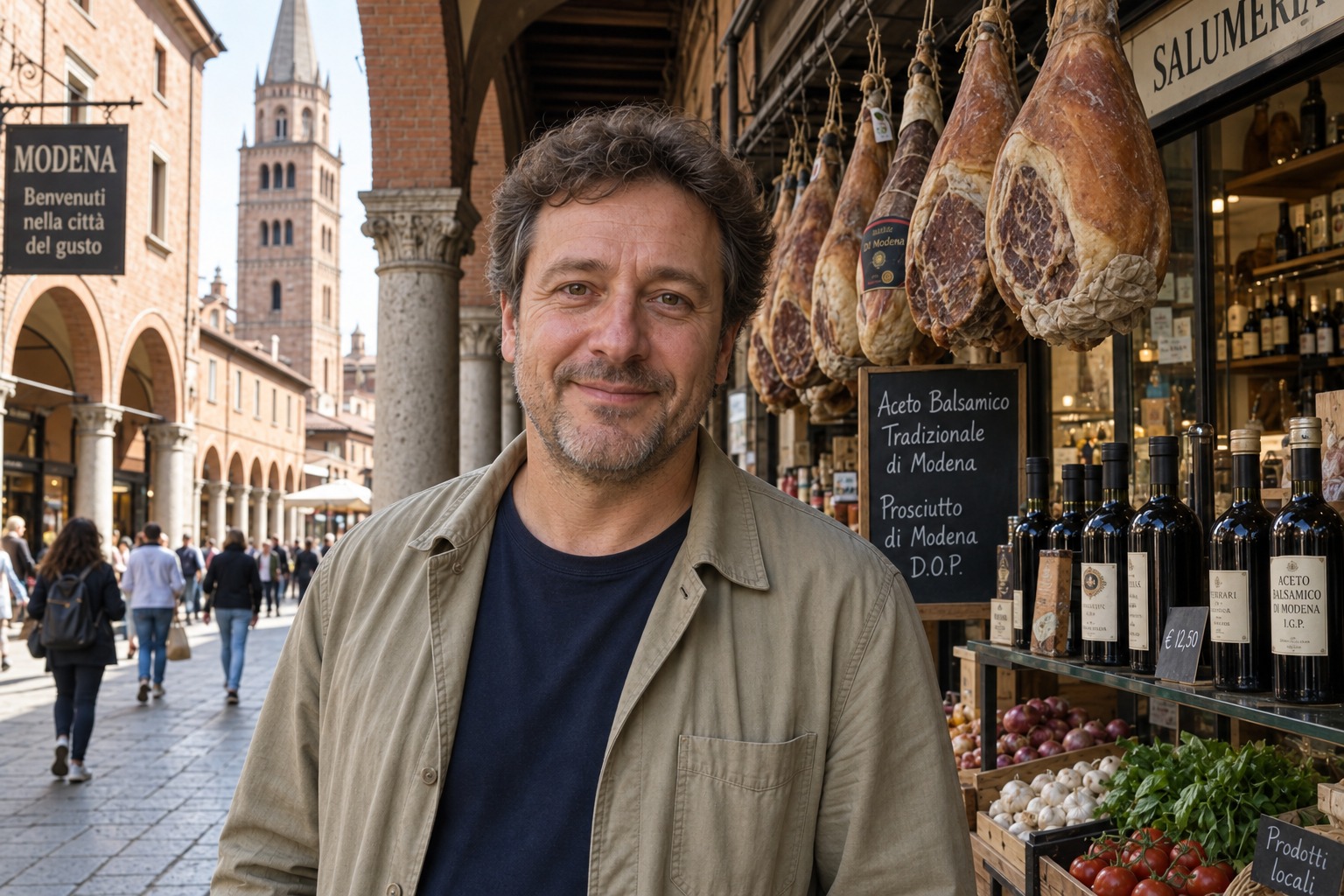 By Marco Montanari, Modena food tour guide and Emilian culinary specialist
The four reliable checks are the numbered seal, the bottle shape, the density on the spoon and the exact wording on the label. A genuine Aceto Balsamico Tradizionale di Modena DOP carries a non-reusable numbered seal, comes in the Giugiaro bottle, coats a spoon thickly, and says its full regulated name. Anything missing one of those is either the IGP, a different product, or an imitation.
The mistake most visitors make is treating balsamic as one product with a quality spectrum. It is not. Two regulated products share the name and almost nothing else: Aceto Balsamico Tradizionale di Modena DOP, which is cooked grape must aged a minimum of 12 years, and Aceto Balsamico di Modena IGP, which is must with wine vinegar added and a minimum of 60 days in wood. Both can be excellent. But they are different things, priced differently, and the checks that identify one do not apply to the other. Getting that distinction straight is the first quality check of all, and it is the one that catches out most of the bottles sold in airport shops and souvenir stalls. The two consortia explain the difference plainly on their own sites, and the DOP consortium's one-line summary states it directly: the DOP comes from cooked must alone and ages 12 or 25 years minimum, while the IGP adds wine vinegar, and the DOP's rules are stricter on both origin and where each stage may happen (balsamicotradizionale.it).
The good news is that you do not need a chemistry lab. Every check in this article can be run at a tasting counter, in a market stall or in the loft of an acetaia, with the bottle in your hand and a spoon in the other. Modena is the one place where you can run all of them in a single afternoon, and the people pouring will expect you to ask.
How To Tell If Balsamic Vinegar Is High Quality?
Run the checks in order: read the label for the full regulated name, look for the numbered seal and the mandatory bottle shape if it claims to be DOP, tilt the spoon to judge density, and finally taste for the balance of sweet and acid with no sharp vinegar bite. A bottle that passes all four is the real product at the age it claims. One that fails the first check never gets to the spoon.
Start with the label because it costs nothing and settles most cases immediately. The wording is regulated, and the words that are missing matter as much as the words that are present. Then move to the physical checks, the seal and the bottle, which apply to the DOP only. The spoon test and the taste test come last, because they need the bottle open and a drop poured.
The reason the order matters is that imitations are designed to pass the taste test with casual tasters. A cheap condiment with added sugar and caramel can taste pleasant. It cannot fake a numbered seal, a consortium-registered bottle shape or the regulated name. The paperwork checks are harder to counterfeit than the flavour, so run them first. Our fuller comparison of the two products is in the guide to DOP versus IGP balsamic, which goes deeper on the production rules than a tasting-table checklist can.
| Check | What to look for | What it proves | What a fail means |
|---|---|---|---|
| Label wording | Full regulated name, plus "DOP" or "IGP" and the EU logo | The bottle claims a regulated product | An imitation or an unregulated condiment |
| Numbered seal (DOP) | Non-reusable seal, serial starting "A" or "E" | Bottled and certified inside the consortium system | Not certified DOP |
| Bottle shape (DOP) | Spherical body on a rectangular base, crystalline glass | The mandatory Giugiaro design | Not DOP, whatever the label implies |
| Spoon density | A drop coats the spoon and slides slowly | Long ageing and concentration | Young, thin or diluted product |
| Taste balance | Sweet and acid in equilibrium, no sharp bite | Properly aged must | Wine vinegar dominance or added sugar |
What Does The Label Have To Say, Exactly?
A genuine bottle must carry the full name of the product it claims to be: "Aceto Balsamico Tradizionale di Modena" with "Denominazione di Origine Protetta" or "DOP", or "Aceto Balsamico di Modena" with "Indicazione Geografica Protetta" or "IGP", plus the EU logo. A label showing only "balsamico" or only "Modena" is an imitation, and that is a rule you can apply in seconds.
The IGP consortium publishes exactly three checks for its own product: the full name "Aceto Balsamico di Modena", the words "Indicazione Geografica Protetta" or the letters "IGP", and the yellow-and-blue EU PGI logo (see Three Types of Parmesan). All three together identify the real thing; any one missing means you are holding something else (consorziobalsamico.it). The same logic applies to the DOP with its own name and logo.
For the DOP there is a second, less known label check that separates the connoisseur bottles from the marketing ones. The disciplinare expressly bans the words "extra", "fine", "scelto", "selezionato", "riserva", "superiore" and "classico" on a DOP label, and bans any vintage year. The only extra wording permitted on the entire bottle is "Extra Vecchio", the 25-years-and-over grade. So a bottle labelled "Riserva" or "Selezione" that also claims to be Traditional Balsamic is breaking the rules of the product it claims to be, which tells you something about the producer.
| Label phrase | Legal on DOP? | Legal on IGP? | How to read it |
|---|---|---|---|
| Aceto Balsamico Tradizionale di Modena DOP | Yes, required | No | The 12-year-or-more aged must product |
| Extra Vecchio | Yes, only extra wording allowed | No | The DOP grade aged 25 years or more |
| Aceto Balsamico di Modena IGP | No | Yes, required | The must-plus-wine-vinegar product |
| Invecchiato | No | Yes, over 3 years in wood | An IGP ageing claim |
| Riserva | No | Yes, over 5 years in wood | An IGP ageing claim, never a DOP one |
| "Balsamico di Modena" alone | No | No | Not a regulated claim; treat with caution |
| Any vintage year | No, banned | Not regulated | A red flag on a DOP-style bottle |
One more label habit worth adopting: check the ingredient list on anything that is not DOP. The IGP rules permit grape must, a minimum of 10 percent wine vinegar, a share of vinegar at least 10 years old, and up to 2 percent caramel for colour. Nothing else may be added. If you see sugar, thickeners, preservatives or colouring beyond that, the bottle is not even playing by the IGP's own rules.
Why The Bottle Shape And The Seal Matter So Much?
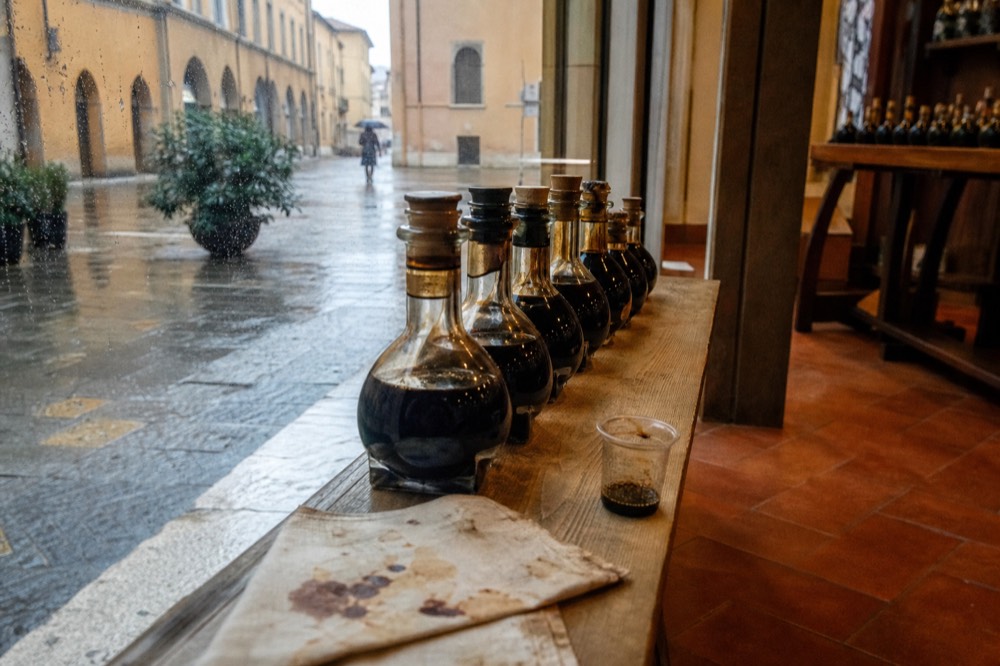
Every bottle of Aceto Balsamico Tradizionale di Modena DOP comes in the same mandatory bottle: a spherical body on a rectangular base in solid white crystalline glass, designed by Giorgetto Giugiaro in 1987, closed with a non-reusable numbered seal. The shape is not a brand choice, it is required by the disciplinare, which is why it works as a check.
The seal is the stronger of the two checks. Each one carries a serial number that begins with "A" for the 12-year Affinato grade and "E" for Extra Vecchio, plus a second algorithm-linked number as an anti-counterfeit control. The seal cannot be broken without opening the bottle, so a sealed bottle with the right serial format has passed the consortium's binding analytical and sensory examination. Nothing may be sold as DOP without passing it, and bottling may only happen inside the province of Modena.
On sizes, one correction to a claim that travels widely: the 100ml Giugiaro bottle is the famous retail size, but it is not the only permitted one. The disciplinare permits 10cl, 20cl or 40cl in the same mandatory shape. A larger DOP bottle is not automatically suspect, and a seller who tells you 100ml is the only legal size is overstating the rule.
The IGP has no equivalent bottle rule at all. It may be sold in glass, wood, ceramic or terracotta from 0.1 litres up to 5 litres, and even in single-dose sachets up to 25ml. So the bottle-shape check only ever applies in one direction: a Giugiaro bottle supports a DOP claim, but a decorative flask tells you nothing either way about an IGP.
What Does The Spoon Test Actually Show?
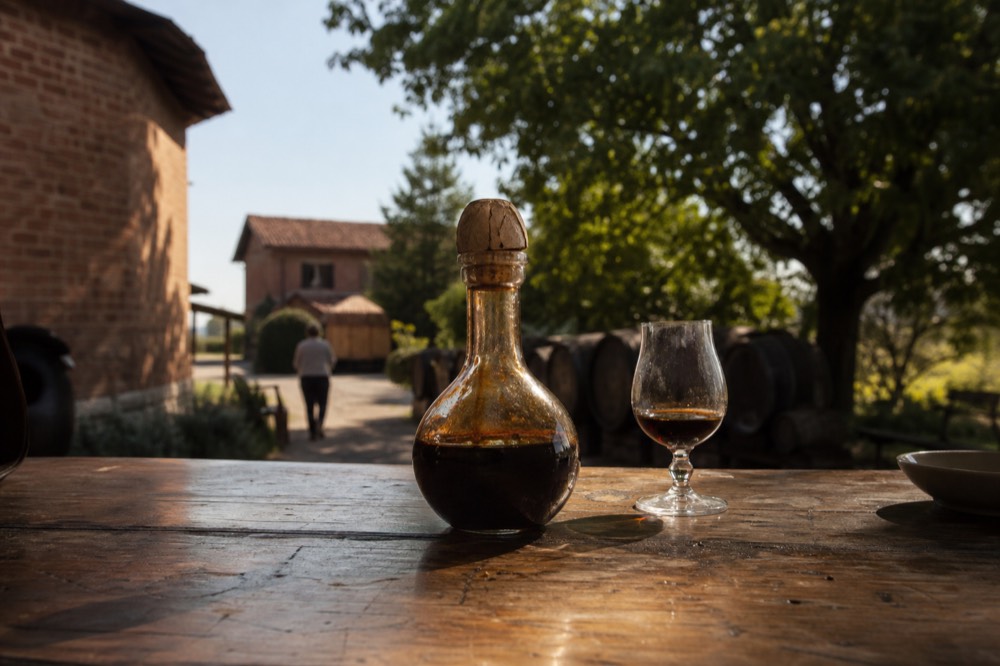
Density is the single most telling physical check on an open bottle: a drop of well-aged DOP balsamic is thick and glossy, coats the spoon, and slides slowly toward the edge when you tilt it. The disciplinare sets a minimum density of 1.240 at 20 degrees Celsius, a figure the product can only reach through years of evaporation in small wooden barrels.
You cannot measure density by number at a counter, but you do not need to. The visual difference between a 12-year Tradizionale and a young condiment is dramatic. The DOP sits on the spoon like syrup; a supermarket balsamic runs off like vinegar. Tilt the spoon slowly and watch the speed. Then watch the drop fall back into the bowl: an aged balsamic leaves a coating on the spoon and a slow, rounded drop (see Balsamic Grades).
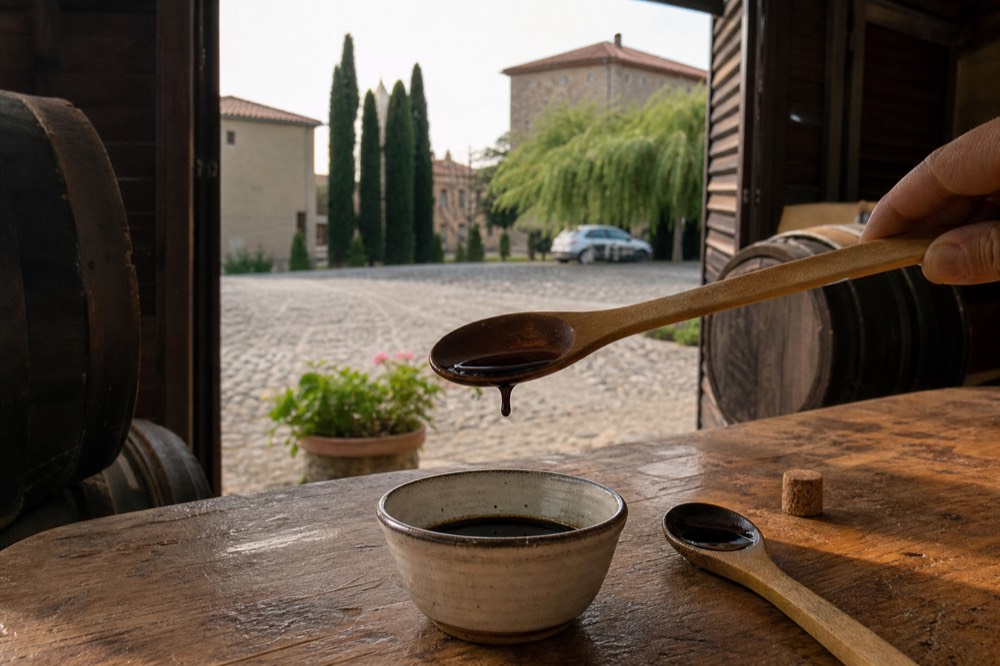
Why does this work? Because nothing is added to the DOP after cooking. The must is cooked over direct flame in open vessels for at least 30 minutes at no less than 80 degrees, then only the "madre" bacterial culture joins it. Everything after that is loss: year after year of water evaporating through the wood of progressively smaller barrels, each numbered and marked, in a graded battery the producer decants through in sequence. Thickness is literally the arithmetic of that patience. A thin product cannot have been through it, and no label claim can argue with a spoon.
The same test is honest on an IGP too, with a different expectation. A well-made Invecchiato or Riserva IGP, three or five years in wood, will show more body than a 60-day bottle. It will not show DOP syrup. Judging each product against its own standard is the whole skill.
What Should High-Quality Balsamic Taste Like?
A well-aged Tradizionale hits the palate as a balance: sweet and sour in equilibrium, round and full in the mouth, with acidity that carries the flavour rather than cutting it, and a long finish that keeps changing. The failure modes are just as recognisable: a sharp vinegar bite means wine vinegar dominance, and a flat sugary sweetness means added sugar in a product that should not have it.
Taste it the way the tasters do, in small drops, and give it a moment. The DOP's flavour comes from cooked must and wood and time, so it reads as cooked fruit, a slight woody warmth and a clean acidic lift. The acidity is real, at least 4.5 grams of acetic acid per 100 grams at consumption, but in a balanced bottle it is woven in rather than standing apart.
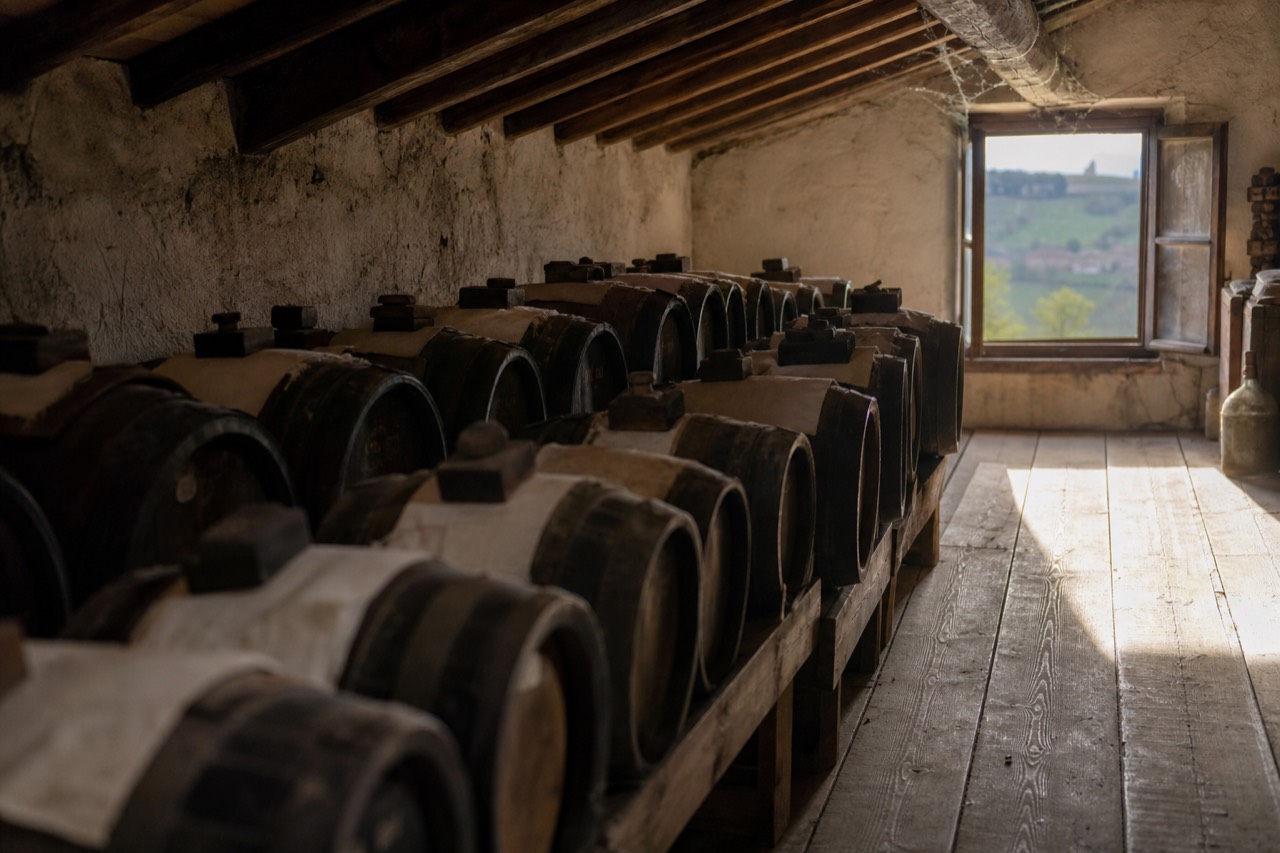
The comparative tasting is where this becomes easy to learn, and it is the reason acetaia visits pour several vinegars side by side. At Castelvetro, La Vecchia Dispensa runs a tasting that puts the very old reserves next to the young ones, across barrels over a century old, which is exactly the calibration exercise: same producer, same method, different ages, and the differences land without anyone explaining them.
If you want the contrast drawn even more sharply, the Gambigliani Zoccoli cellar near Nonantola pours its vinegar over a full sit-down Emilian lunch, so you taste the same family's product both alone and dressed onto food, which is how Modenese households actually use it.
A note on the myth of extreme age. There is no such thing as a 50-, 100- or 200-year-old Traditional Balsamic; only the barrels can be that old. The consortium says so itself. The product in the bottle is either Affinato, aged at least 12 years, or Extra Vecchio, aged at least 25. A producer speaking of century-old barrels is describing the battery, not the contents, and that is honest. A label promising 100-year vinegar is not.
Where Can You Run These Checks In Modena?
The best places to run all four checks in one sitting are the acetaie that take booked visits, the Museo del Balsamico Tradizionale in Spilamberto, and the dedicated stalls at Mercato Albinelli. At an acetaia you see the barrels the claims rest on; at the museum you see the history; at the market you practise on bottles with no one guiding you, which is the real test of what you have learned.
The consortium's own FAQ makes a point that surprises visitors: many acetaie take booked guided visits, and the tasting on such a visit is free, with the consortium offering an interactive map to pick one and contact it. That is the cheapest possible education in this subject, and it comes with the producer in the room to answer the seal and barrel questions directly. Our guide to acetaia visits around Modena covers how those arrangements work and what to expect from the barrel loft.
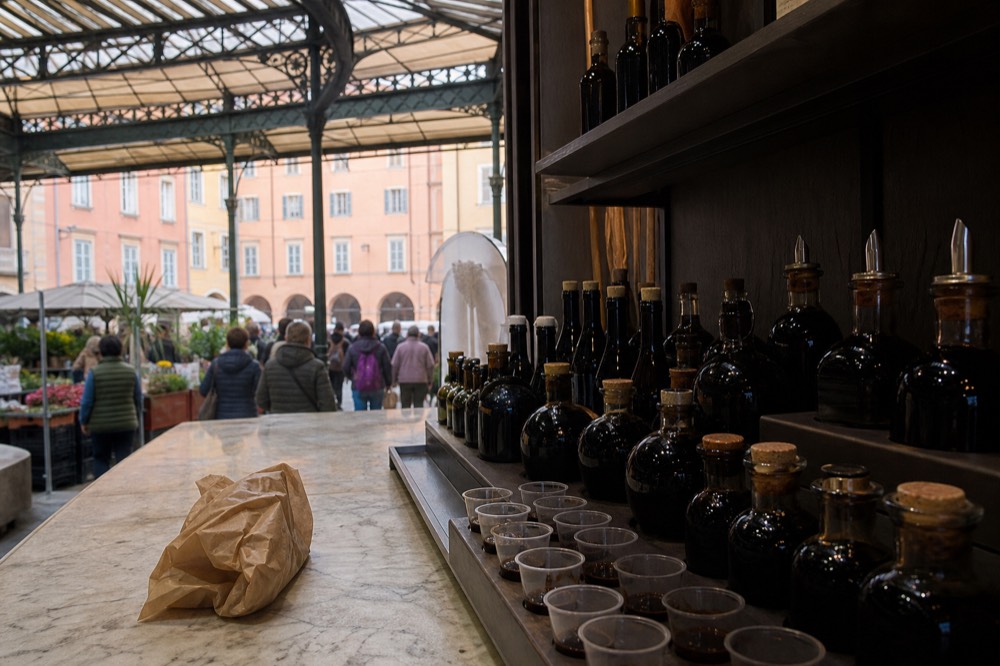
In the city itself, the shortest route to a one-to-one tasting is a private session at a city acetaia, hosted individually rather than as a scheduled group slot, where there is time to ask the label questions without holding up a queue. Check the current price and the next available dates on the live listing before you plan the day around it.
Spilamberto, a short bus ride from Modena on SETA line 731, holds the Museo del Balsamico Tradizionale, run by the Consorteria, which exists specifically to explain this one DOP product and distinguish it from everything else on a shelf. It opens Tuesday to Sunday, with guided visits at fixed times through the day, and it is the place where the seal, the bottle and the barrel battery are laid out as exhibits rather than as sales talk (museodelbalsamicotradizionale.org).
| Place | What you can check there | Best for |
|---|---|---|
| A booked acetaia visit | Seal, bottle, spoon test, taste, plus the barrels themselves | Learning the full method end to end |
| Museo del Balsamico Tradizionale, Spilamberto | Bottle, seal and history as exhibits | Understanding the product's rules |
| Mercato Albinelli stalls | Label wording and bottle shape, unguided | Practising the checks under no pressure |
| Acetaie Aperte, Sunday 27 September 2026 | Everything, across over 30 open acetaie | Comparing producers in one day |
If your timing is flexible, one date stands out: Acetaie Aperte, the consortia's joint open day, falls on Sunday 27 September 2026, with over 30 acetaie opening their doors for guided visits and tastings of both the IGP and the DOP. Several take bookings only, so it rewards planning ahead. And if you want to take bottles home afterwards, our guide on buying real balsamic in Modena walks through the same checks from the buyer's side of the counter, including what to expect to pay for each grade. The site behind this article, Food Tours in Modena, keeps a full roster of balsamic experiences if you would rather learn the checks with a glass already poured.
The short answers: check the label for the full regulated name and logo, demand the numbered seal and Giugiaro bottle on any DOP claim, tilt the spoon for density, and taste for sweet-acid balance without a sharp bite. The questions below cover the details, including the two-product distinction, the myth of 100-year vinegar and whether a 100ml bottle is really the only legal size.
Common Questions About Spotting Quality Balsamic
How To Tell If Balsamic Vinegar Is High Quality?
Check the label for the full regulated name and logo, look for the numbered seal and Giugiaro bottle if it claims to be DOP, test the density on a spoon, and taste for sweet-acid balance without a sharp vinegar bite. A bottle that passes the label, seal and bottle checks and then coats the spoon slowly is the real product at the age it claims.
What Is The Difference Between Aceto Balsamico Tradizionale Di Modena DOP And Aceto Balsamico Di Modena IGP?
The DOP is cooked grape must alone, aged a minimum of 12 years, bottled only in the province of Modena in the mandatory Giugiaro bottle with a numbered seal. The IGP is grape must with at least 10 percent wine vinegar added, matured a minimum of 60 days in wood, and sold in many container types. They are different products, not two quality levels of the same one.
Is A Thicker Balsamic Always Better?
Within the same product type, yes, more thickness generally means longer ageing and more evaporation, since nothing is added to thicken the DOP. But thickness alone does not tell you which product you are holding, and a young IGP can be pleasant without being syrupy. Judge density against the standard of the product named on the label.
Can A 100-Year-Old Balsamic Vinegar Exist?
No. The consortium states it plainly: only the barrels can be a century old. The product in the bottle is either Affinato, aged at least 12 years, or Extra Vecchio, aged at least 25 years. Any label or seller promising 50 or 100 year vinegar is describing the barrel battery, or inventing the claim.
Is The 100Ml Bottle The Only Legal Size For Traditional Balsamic?
No. The disciplinare permits 10cl, 20cl or 40cl in the same mandatory Giugiaro shape. The 100ml bottle is the common retail size, not the only permitted one, so a larger DOP bottle is not automatically suspect.
Do I Need To Visit An Acetaia To Learn These Checks?
No, but it is the fastest way to calibrate your palate. Many acetaie take booked visits and the tasting on such a visit is free, per the consortium's own FAQ. A side-by-side tasting of old reserves next to young vinegars teaches the difference in one sitting in a way no article can.