Mercato Albinelli Modena: Opening Hours, Closures And What To Buy
Mercato Albinelli has been Modena's covered food market since 1931, and it is the one place in the city where the producers, the cooks and the shoppers all share the same roof. The catch is timing: the stalls and the restaurants inside keep completely different hours, and getting that wrong is the most common mistake visitors make.
Short answer
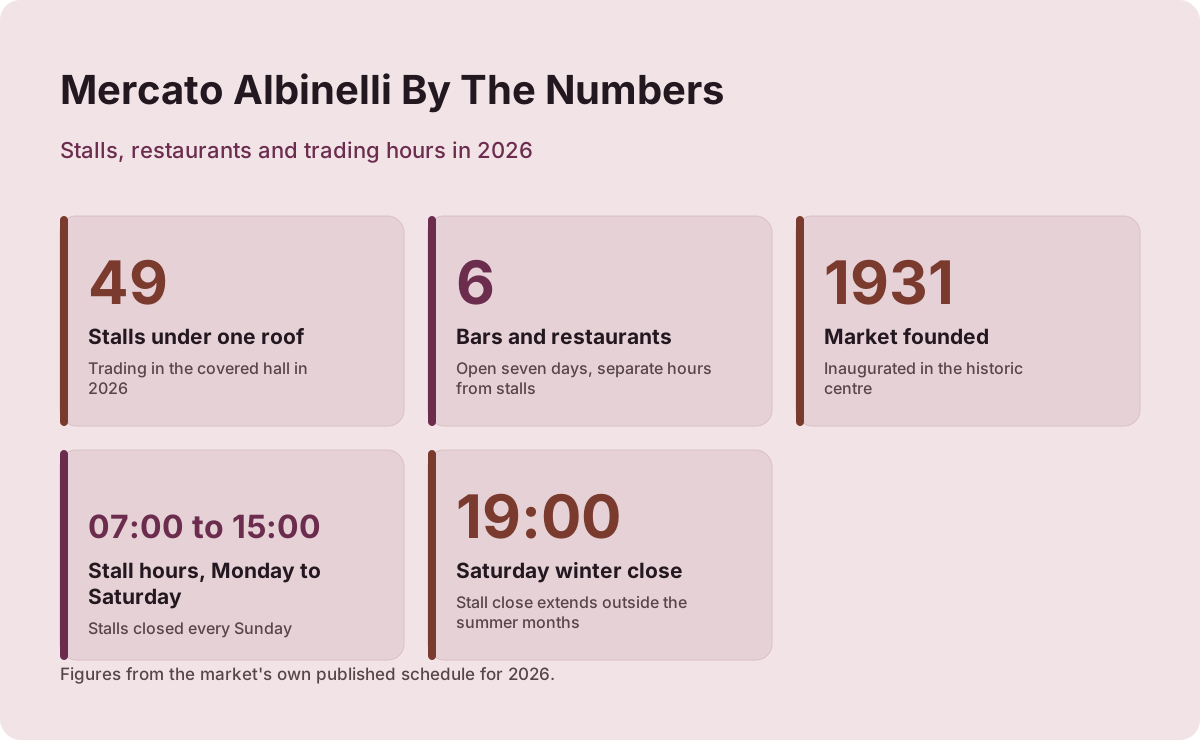
Mercato Albinelli's stalls open Monday to Saturday 07:00-15:00 and close every Sunday. The market restaurants inside open seven days, including Sunday, for lunch and dinner service. The market also closes on listed 2026 holidays including 15 August and 25-26 December, with extra Sunday openings on 20 September and three December dates.
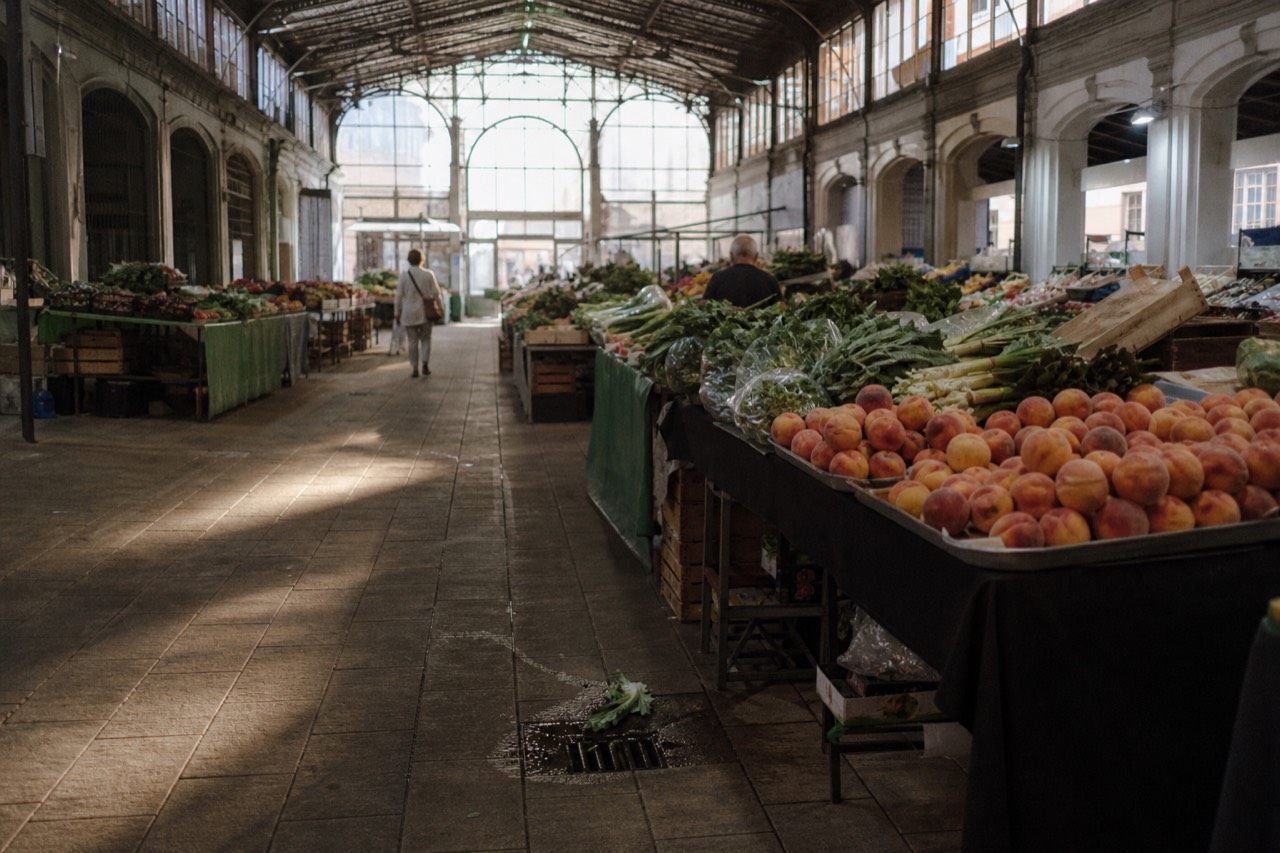
Mercato Albinelli has been trading since 1931, and the market's own strapline, "every morning since 1931", is not marketing fluff. The covered hall at Via Luigi Albinelli 13 holds 49 stalls and 6 bars and restaurants in 2026, which makes it the densest concentration of Modenese food shopping anywhere in the historic centre. Cheesemongers, salumieri, fishmongers and bakers trade under one arched roof, a few steps from Piazza Grande.
The reason this guide exists is that most visitors get the timing wrong. The stalls shut at 15:00 and are dark on Sundays, while the restaurants inside keep entirely different hours and serve on Sundays. Arrive at 17:00 on a Sunday expecting a market and you will find closed shutters and open dinner tables. The split, the closure calendar and the honest divide between what to buy here and what to eat standing at a counter are laid out below, with the hours taken from the market's own site. This page is part of Food Tours in Modena, our coverage of the city's food tours, producer visits and market culture.
What Is Mercato Albinelli And Why Does It Matter?
Mercato Albinelli is Modena's historic covered food market, inaugurated in 1931, holding 49 stalls and 6 bars and restaurants under one roof in the heart of the historic centre, and it is where the city's cooks and families actually shop, which makes it the most useful single stop for a visitor who wants to understand what Modenese food is built from.
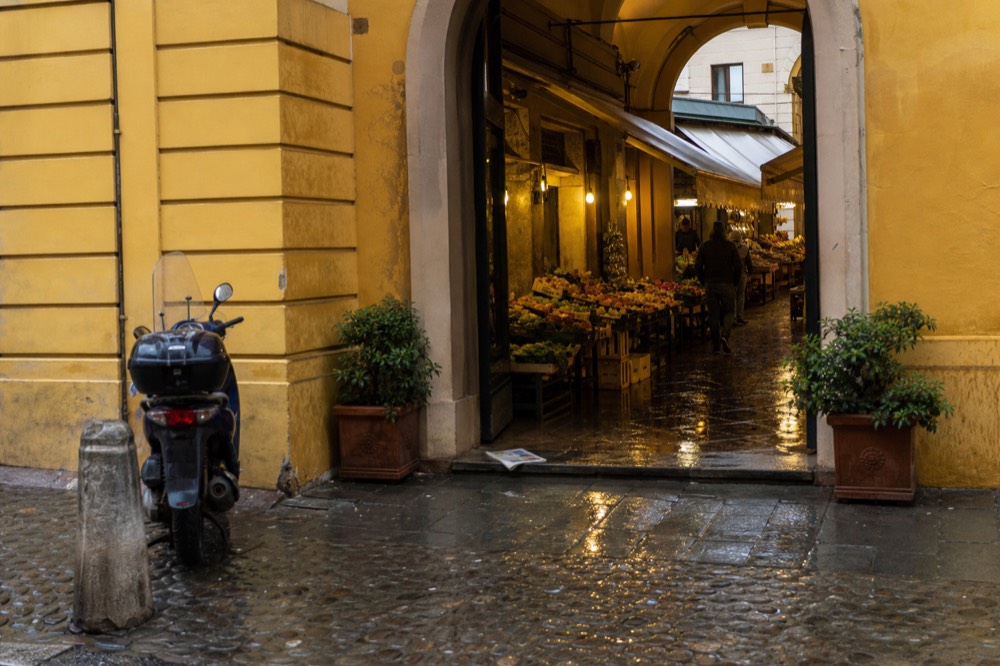
The market sits inside the old city, with its main entrance at Via Luigi Albinelli 13 and further entrances from Via Mondatora and Piazza XX Settembre. That position matters: this is not a suburban shopping centre or a tourist market on the edge of town. It is the working pantry of the centre, a short walk from the Ghirlandina tower and the Duomo, and the stallholders are the same people who supply the city's trattorie.
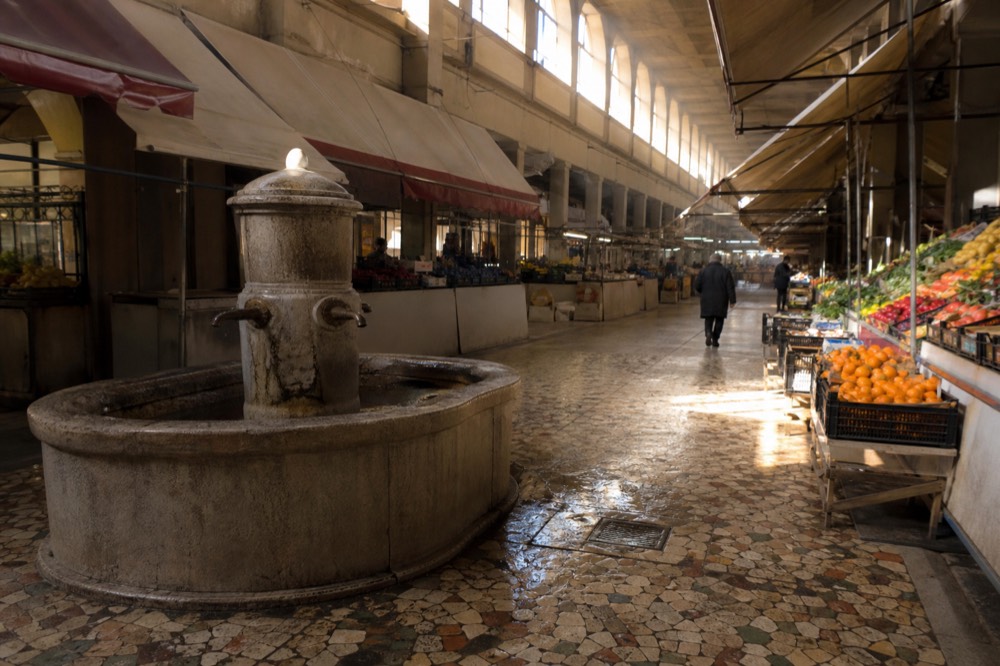
The hall itself has a period feel that survives the daily trade. At the centre stands a fountain with the "Portatrice di frutta" sculpture by Giuseppe Graziosi, the fruit-bearing girl with a basket of flowers who has watched over the stalls for the better part of a century. The architecture, the fountain and the 1931 founding are all part of why the market reads as a place rather than a facility.
For a food traveller the market does three things at once. It shows you the raw materials of the Modenese kitchen, from the cheese counter to the pasta sheets. It feeds you, at the counters and at the restaurants inside. And it sells you things to carry home, from vacuum-packed Parmigiano Reggiano to small bottles of balsamic, at prices that are generally keener than the souvenir shops around Piazza Grande (see Parmigiano vs Parmesan).
When Is Mercato Albinelli Open?
The stalls at Mercato Albinelli open Monday to Saturday from 07:00 to 15:00, with the Saturday close extending to 19:00 in winter, and they are closed every Sunday; the restaurants inside keep separate, longer hours and open seven days, so the honest answer depends on whether you are coming to shop or to eat.
Those stall hours come from the market's own published schedule, and they shape the whole day. The market is a morning place. By 07:00 the bakers are already stocked, the fish counters are at their best and the cheesemongers are cutting to order. By early afternoon the stall trade winds down, and by 15:00 the shutters come down across the stall aisles even as the restaurants keep serving.
The Sunday closure is the single most important planning fact on this page. The stalls do not open on Sundays, full stop. If your only day in Modena is a Sunday and you want the market experience, the restaurants inside are your option, or you shift the market to another day and spend the Sunday elsewhere, perhaps at a producer visit outside the city (see Bottura's Restaurants).
The holiday calendar matters too. The market publishes its closure dates for the year, and in 2026 the stalls are shut on 5 and 6 April, 25 April, 1 May, 2 June, 15 August, 1 November, and 25 and 26 December. Ferragosto, 15 August, is the one that catches summer travellers: the whole stall market is closed that day, so plan around it if you are in Emilia-Romagna in mid-August.
| Day | Stalls (07:00-15:00 base) | Restaurants inside |
|---|---|---|
| Monday to Friday | Open, full trade | Open, lunch and dinner service |
| Saturday | Open; closes 19:00 in winter | Open, lunch and dinner service |
| Sunday | Closed | Open, lunch and dinner service |
| Listed 2026 holidays | Closed | Check with each restaurant |
The market's own site carries the current hours, the entrance list and the holiday calendar, and it is the source worth checking before an early-morning visit: Mercato Albinelli official site.
If a self-guided morning feels like hard work, a guided walk that routes through the market with tastings at each stop is the easiest fix, and the trio below covers the formats that do it best.
Stalls Or Restaurants: Which Part Of The Market Is Open When?
Inside Mercato Albinelli the 49 stalls and the 6 restaurants run on two different clocks: the stalls trade Monday to Saturday in the morning and early afternoon and never on Sundays, while the restaurants open seven days a week for a midday service and an evening service, which means lunch and dinner are always possible but shopping is not.
This split is the detail that trips people up, so it deserves its own section. The restaurants are separate businesses from the stalls, with their own doors and their own hours. On a Sunday, when every stall shutter is down, the restaurants are serving. In the evening, when the stall aisles are dark, the restaurants are doing dinner service. The two halves of the market share a roof and nothing else in their schedules.
The practical consequences are worth spelling out. A Sunday visitor can eat well inside the market but cannot buy cheese, bread or fish. An evening visitor has the same experience in reverse. A Saturday-afternoon visitor in winter has a bonus window, because the Saturday stall close extends to 19:00 outside the summer months, which is the one moment the two clocks nearly align.
For exact service times at each restaurant, check the market's site or the individual restaurant listings, because the midday and evening seatings are set per venue and shift between seasons. The safe generalisation is that lunch starts around midday and dinner service begins in the early evening, and that no restaurant inside depends on the stalls being open.
| Time of day | Stalls | Restaurants | Best use |
|---|---|---|---|
| 07:00-10:00 | Full trade, freshest counters | Closed or prepping | Photography, serious shopping |
| 10:00-13:00 | Full trade | Opening for lunch | Shop, then eat |
| 13:00-15:00 | Winding down | Lunch service | Standing lunch at a counter |
| After 15:00 | Closed (Sat winter: to 19:00) | Dinner service later | Sit-down dinner only |
What Should You Buy At The Market?
The best buys at Mercato Albinelli are Parmigiano Reggiano cut from the wheel at the formaggeria, cured meats sliced to order at the salumeria, fresh egg pasta from the pasta counters, and Lambrusco by the bottle, all things that travel well, all sold by people who cut and slice in front of you, and all cheaper than the equivalent in the souvenir streets around Piazza Grande.
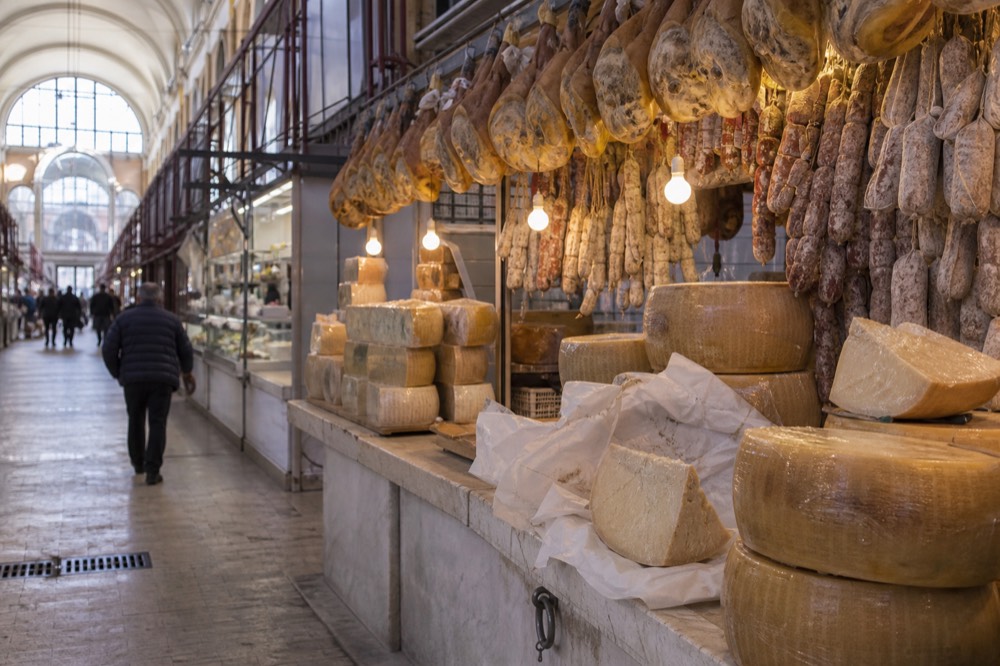
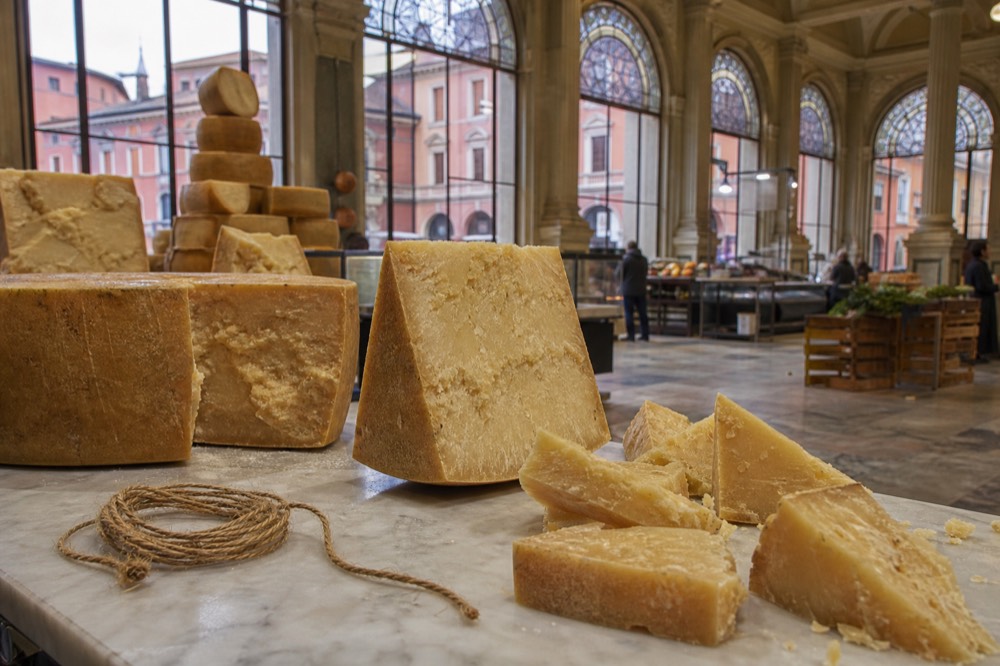
Start at the cheese counter. The formaggerie inside the market, including Formaggeria Martinelli among the named 2026 stalls, cut Parmigiano Reggiano to order from whole wheels, and the staff will vacuum-pack pieces for the flight home (see Dairy Factory Tours). When you buy, look at the rind: the dotted lettering spelling out the name is the origin mark, and the oval fire brand reading "Consorzio Tutela Parmigiano-Reggiano" is applied only at 12 months to wheels that passed inspection, a system explained by the Consorzio itself at parmigianoreggiano.com. A wedge with those marks is the real thing, whatever the price tag says.
The salumeria counters are the second stop. Prosciutto, culatello, salame di felino and mortadella are sliced to your thickness, wrapped in paper and packed for travel. The fishmongers, including named stalls like Pescheria Laritonda, are worth a look even if you are not cooking, because a busy Italian fish counter is one of the best free shows in the market.
For wine, the market is a sound place to buy Lambrusco to carry home. The label is the thing to read: there are six Lambrusco DOC denominations in total, four of them in Modena province, and the denomination name on the label, Sorbara or Grasparossa di Castelvetro for example, tells you the style before you open it. The consortium's own denomination guide at lambrusco.net is the reference worth having on your phone while you shop.
If a purchase turns into a plan, check the current price of a guided market walk before you commit to a self-guided hour: the short city walk that includes the market with tastings is listed on the operator's live page at the market and city highlights walk, and Check availability if the timing works.
| Counter | What to ask for | Travels? |
|---|---|---|
| Formaggeria | Parmigiano Reggiano cut from the wheel, vacuum-packed | Yes, days |
| Salumeria | Mortadella, prosciutto, local salami sliced to order | Yes, chilled |
| Pasta counter | Fresh tagliatelle and tortellini for cooking tonight | No, same day |
| Panetteria | Tigelle, gnocco fritto dough, bread | A day or two |
| Wine and vinegar | Lambrusco by denomination, balsamic from Modena | Yes, packed |
What Can You Eat Standing At A Counter?
The honest answer is a real lunch: tortellini in brodo served at a counter inside the market, porchetta sandwiches, tigelle with cold cuts, pizza slices and gnocco fritto with salumi, all eaten standing or perched at a bar stool for the price of a snack, and all of it a genuine piece of Modenese daily eating rather than a tourist version of one.
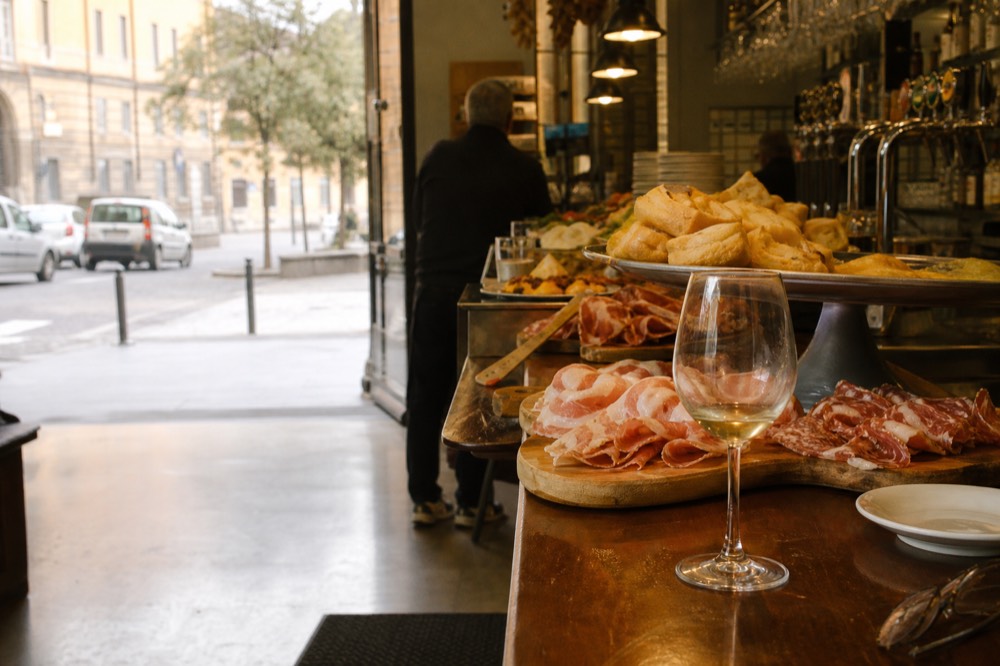
The counter culture inside Albinelli is the market's best-kept open secret. Local guides describe stalls serving tortellini in brodo at a counter known as Marisa, porchetta sandwiches, tigelle and pizza slices through the day. One bar inside the market, MozzaBella at Via Luigi Albinelli 13, lists gnocco fritto or focaccia as an addition to its salumi boards for a few euros, with taglieri running roughly 10 to 18 euro, which frames the price level: a standing lunch here costs snack money, not restaurant money.
The divide between buying and eating is the point of this section. Buy the Parmigiano and the Lambrusco to take home, but eat the tortellini here, because fresh egg pasta does not travel and broth does not travel at all (see Tortellini and Broth). The standing counters are also the fastest lunch in the centre: you can be in, fed and out in half an hour, which matters on a day that also has a dairy visit or a museum in it.
The one constraint is the clock. The standing food lives and dies with the stall hours, so it exists Monday to Saturday and disappears on Sundays and holidays. A Sunday lunch inside the market means the restaurants, not the counters. Plan the standing lunch for a weekday morning and you get the market at its most alive.
| Standing food | What it is | When to eat it |
|---|---|---|
| Tortellini in brodo | Hand-folded pasta in capon broth | Weekday or Saturday lunch |
| Gnocco fritto with salumi | Fried dough pillows with cold cuts | Any open morning |
| Tigelle | Small flatbreads split and filled | Late morning |
| Porchetta sandwich | Sliced roast pork in bread | Lunch on the move |
If standing at counters sounds like guesswork on a first visit, a walk built around the Modenese breakfast, fried gnocco and coffee first, then the market and the salumerie, does the ordering for you: see the walking food tour with a local and check the next available dates on the operator's listing before you build the day around it.
How Do You Fit The Market Into A Food Day In Modena?
The pattern that works is market first, everything else after: shop or eat at Albinelli between 08:00 and 12:00 while the stalls are at full trade, spend the afternoon at a producer outside the city, a Parmigiano dairy or an acetaia, and come back for dinner at one of the market restaurants or elsewhere in the centre, which uses the stall hours as a spine for the whole day.
The morning slot is non-negotiable. The stalls are at their best from opening until about noon: the counters are fully stocked, the aisles are full of local shoppers and the standing food is flowing. After 13:00 the trade thins, and by 15:00 the stall side of the market is finished. A visitor who treats Albinelli as an afternoon attraction has misunderstood what it is.
The afternoon belongs outside the city. Modena's food identity is producer-based, and the dairy and acetaia visits that fill the roster of this site all sit a short drive or bus ride out. A morning at the market and an afternoon at a dairy is the classic Modena food day, and the two halves explain each other: the wheel you saw made in the morning is the wedge you buy at the formaggeria.
For the full picture of what to eat across the city, including the dishes you will find at the market counters, our guide to what to eat in Modena covers the territory dish by dish. And if the shopping inspires you to cook rather than only eat, the cooking classes in Modena guide lists the formats where you roll the pasta yourself.
| Time | Where | What |
|---|---|---|
| 08:00-10:00 | Mercato Albinelli | Coffee and market breakfast, first shopping |
| 10:00-12:30 | Market counters | Standing lunch or shopping finish |
| 14:00-17:00 | Producer visit outside the city | Dairy, acetaia or cellar tour |
| 19:30 onwards | Centre or market restaurant | Sit-down dinner |
How Do You Get To Mercato Albinelli?
Mercato Albinelli is inside Modena's historic centre at Via Luigi Albinelli 13, reachable on foot from anywhere in the old city in minutes, but it sits inside the ZTL, the limited-traffic zone, which runs Monday to Friday 07:30-19:30 and Saturday 07:30-13:30 per the market's own note, so driving to the door is a mistake and walking, bus or taxi is the plan.
The ZTL detail matters more than most visitors expect. The market's own contact page states the restricted hours plainly, and the cameras enforce them around the clock. If you have a rental car, leave it in a car park outside the restricted streets and walk in. The market's newsstand doubles as a booking point for Radiotaxi Modena Cotamo, with a euro off each fare, which is the market's own solution for leaving with heavy bags (see Days in Modena).
The three entrances make the approach simple. The main door is on Via Luigi Albinelli at number 13, and the other two, from Via Mondatora and Piazza XX Settembre, drop you into the aisles from different sides. Coming from Piazza Grande or the Duomo, any of the three is a walk of a few minutes. Coming from Modena railway station, the walk into the centre is short and flat.
For visitors based in Bologna, the market pairs naturally with a morning train and a day in Modena; our Modena day trip from Bologna guide covers the mechanics. Once inside the hall, everything is under one roof, so weather and opening entrances are never a factor.
When Is The Market Worth Building A Trip Around?
There are four dates in 2026 when the stalls open on a Sunday, 20 September for the Festival Filosofia weekend and 6, 13 and 20 December, and a handful of moments when the market becomes more than a market, including the September weekend when Acetaie Aperte opens over 30 vinegar houses across the province, which makes late September the single best stretch to plan a Modena food trip around.
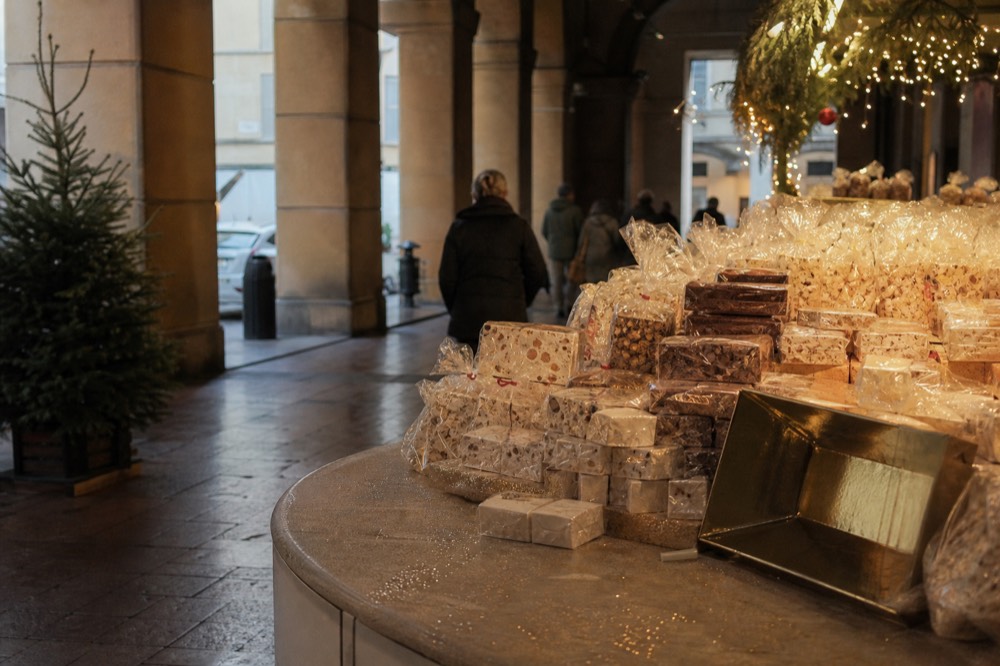
The extra Sunday openings are published by the market itself, and they solve the Sunday problem on those dates only. If your trip falls on 20 September 2026, you can have a full Sunday market morning, which is otherwise impossible all year. The three December Sundays do the same for the festive season, when the market fills with panettone, torrone and gift shopping.
Late September is the richest window of the Modena food calendar. On Sunday 27 September 2026, the Acetaie Aperte event opens more than 30 acetaie across the province for guided visits and tastings of both Aceto Balsamico di Modena IGP and Aceto Balsamico Tradizionale di Modena DOP, and the Castelvetro grape and Lambrusco sagra runs 19 to 27 September in the Grasparossa hills. A market morning, a vinegar-house afternoon and a sagra evening is about as complete a Modena food day as the calendar allows.
For visitors who want the market to lead into cooking rather than just eating, the longest format on offer shops the market with a host first and then moves to her home kitchen to roll pasta and make tiramisu. Check the next available dates on the operator's listing before you build the day around it, because the small-group home formats fill ahead of the walking tours.
| 2026 moment | What happens | Plan around it |
|---|---|---|
| 20 September | Extra Sunday opening, Festival Filosofia | Sunday market morning, rare |
| 19-27 September | Castelvetro grape and Lambrusco sagra | Pair with an afternoon in the hills |
| Sunday 27 September | Acetaie Aperte, 30-plus vinegar houses open | Book ahead, some take bookings only |
| 6, 13, 20 December | Extra Sunday openings | Festive shopping mornings |
The market walk, the breakfast-first walking tour and the market-to-kitchen class below are the three formats that use Albinelli best, and they are worth comparing side by side before you book anything.
The questions visitors ask most about Mercato Albinelli are all about timing and access: whether the stalls open on Sunday, what time the shutters come down, where the entrances are and what is worth buying, and the answers below cover each one plainly, using the market's own published hours and 2026 calendar rather than secondhand summaries.
Common Questions About Mercato Albinelli
Is Mercato Albinelli Open On Sunday?
No. The 49 stalls are closed every Sunday. The 6 restaurants inside the market open seven days a week, including Sunday, for lunch and dinner service, so you can eat inside the market on a Sunday but you cannot shop there. Four extra Sunday stall openings are published for 2026: 20 September and 6, 13 and 20 December.
What Time Does Mercato Albinelli Close?
The stalls close at 15:00, Monday to Saturday, with the Saturday close extending to 19:00 in winter. The restaurants inside keep their own longer hours, with a midday service and an evening service, so the building stays useful after the shutters come down.
Where Is Mercato Albinelli?
The main entrance is at Via Luigi Albinelli 13, inside Modena's historic centre, a few minutes on foot from Piazza Grande and the Duomo. There are further entrances from Via Mondatora and Piazza XX Settembre. The market sits inside the ZTL, so arrive on foot or by taxi rather than by car.
What Should I Buy At Mercato Albinelli?
Buy Parmigiano Reggiano cut from the wheel at the formaggeria, cured meats sliced to order at the salumeria, and Lambrusco by the bottle, reading the denomination on the label. Fresh pasta is best eaten the same day, at a counter inside the market, rather than carried home.
Is Mercato Albinelli Worth Visiting?
Yes, if you time it right. A weekday or Saturday morning gives you the full market at its busiest, with standing lunch options at the counters. A Sunday or late-afternoon visit gives you only the restaurants, which is a different and lesser experience. Treat it as a morning attraction and it earns its place in any Modena food itinerary.
Does Mercato Albinelli Close For Holidays?
Yes. The published 2026 stall closures are 5 and 6 April, 25 April, 1 May, 2 June, 15 August, 1 November, and 25 and 26 December. If your visit falls on one of those dates, plan the market for another day and check the restaurant hours separately.