Parmigiano Reggiano Factory Tour: Which City Should You Leave From?
The Parmigiano Reggiano production zone spans five provinces, so a factory tour is usually named after the city you left rather than the dairy you actually reach. Here is how the three departure cities compare, what a visit really includes, and what it costs.
Short answer
Modena reaches a working dairy fastest: the 4 Madonne caseificio at Lesignana is about 8 km from the city, on a bus line of 9 to 11 minutes, and charges EUR 22 per adult for a roughly one-hour guided visit with tasting. Bologna and Parma both sit inside the zone too, but tours from them usually bundle transport and cost more per person.
The Parmigiano Reggiano DOP zone covers the provinces of Parma, Reggio Emilia, Modena, Bologna left of the river Reno, and Mantova right of the Po, and every stage from milk to packing must happen inside it (see Parma or Modena). That geography has a practical consequence for travellers: a "factory tour from Bologna" and a "factory tour from Modena" often end at the same kind of dairy, sometimes at the same dairy, and the difference you pay for is mostly the transfer (see Balsamic vs Modena Balsamic). The consortium's own territory page is the reference for what the zone includes.
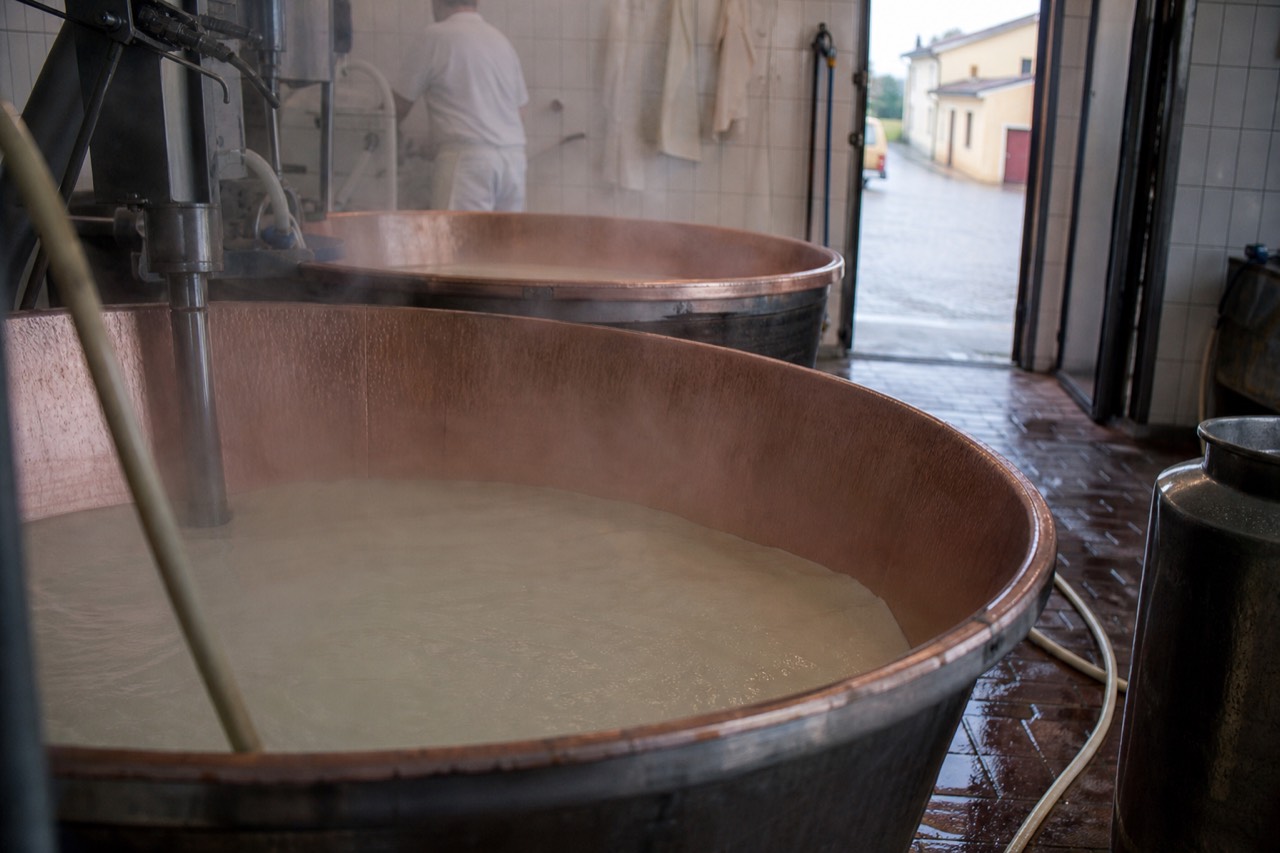
This guide compares the three realistic departure cities, Modena, Parma and Bologna, on speed, cost and what you actually get, and then walks through the visit itself: the copper vats, the salting room, the ageing shelves, the tasting, and the booking mechanics that decide whether you see cheesemaking live or on a screen (see Three Types of Parmesan). It sits alongside Food Tours in Modena as the site's dedicated page on the dairy-visit question, and it uses only figures verified from primary sources.
What Is A Parmigiano Reggiano Factory Tour?
A Parmigiano Reggiano factory tour is a guided visit to a working caseificio, a dairy that makes the cheese under the DOP rules, typically lasting about an hour and moving through the production room, the salting baths and the ageing warehouse, and ending with a tasting of the cheese at several ages. Visits run on reservation only, the cheesemaking itself happens in the morning, and the standard model is a small group walked through by a guide who explains each stage as you stand next to it. It is a food-production visit, not a museum: the vats are live, the workers are on shift, and the wheels you see are the real inventory.
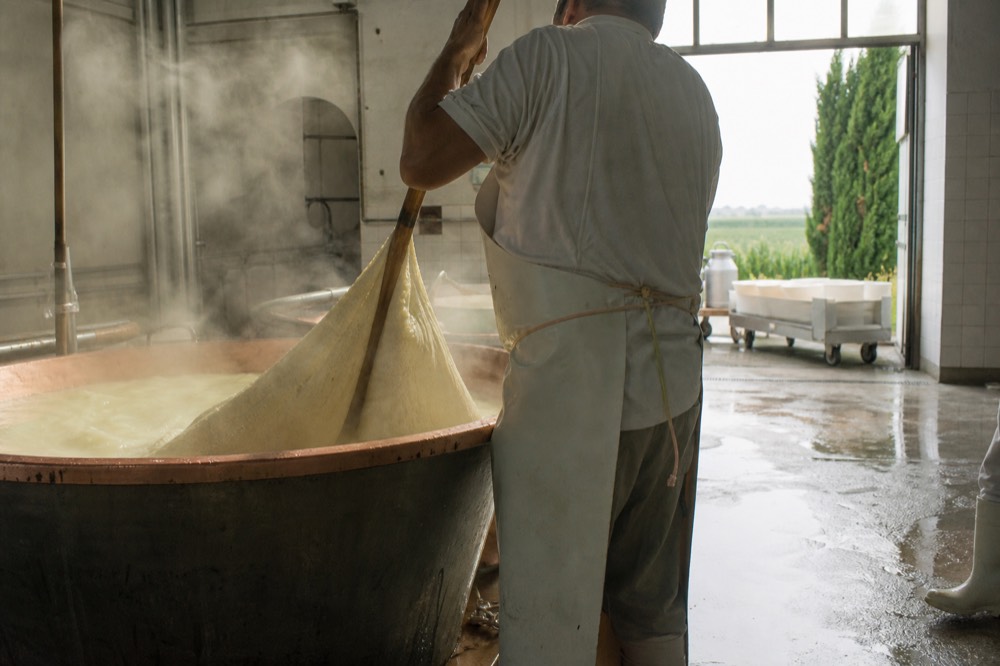
What surprises most visitors is how manual it still is. The curd is cut and lifted by hand with large paddles, the twin wheels are separated and wrapped in cloth, and each wheel is stamped with a casein plate in its first hours carrying a unique alphanumeric code, the letters CFPR and a Datamatrix code, so it can be traced back to the day and the dairy that made it. The consortium's guide to the marks and stamps explains every marking you will see on the rind, and reading it before a visit turns the ageing room from a photo stop into something you can actually decode.
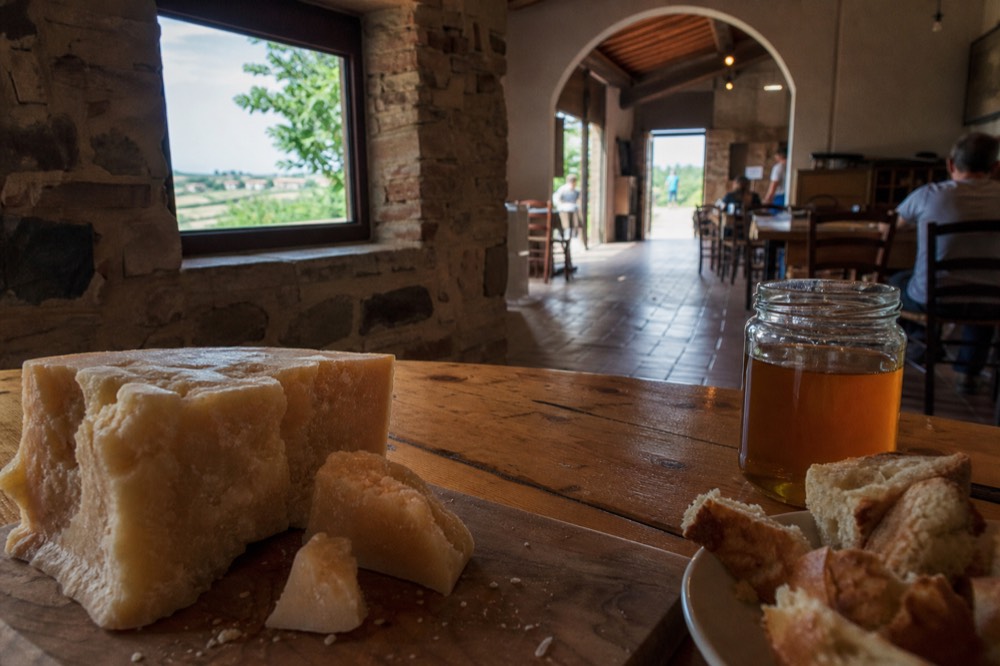
The tasting at the end is not an afterthought. At the dairies set up for visitors it is a structured flight: the same cheese at different ages, so the difference between 12 months and 24-plus is something you taste rather than read about, often with ricotta, young cheese, and pairings like honey or balsamic alongside.
Which Departure City Reaches A Working Dairy Fastest?
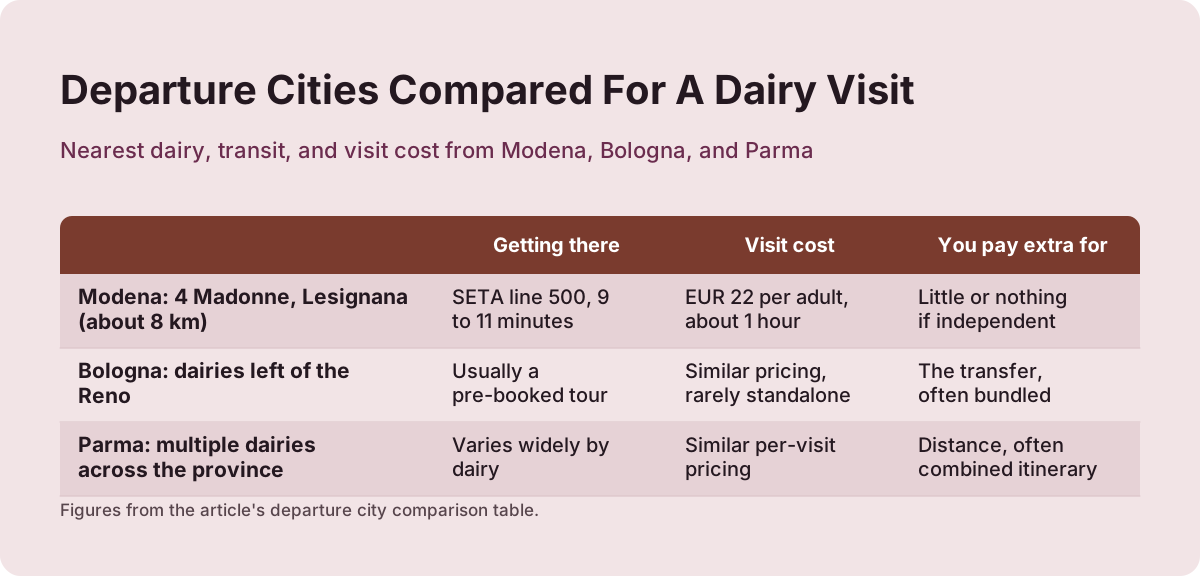
Modena does, by a clear margin. The 4 Madonne caseificio at Lesignana di Modena is roughly 8 km from the city, reachable on a SETA bus line that takes 9 to 11 minutes, and its standard visit costs EUR 22 per adult. Bologna sits inside the production zone too, but its dairies are further out and tours from there usually fold transport into a higher headline price, while Parma's visitor-ready dairies are scattered across the province.
The honest way to compare the three cities is to separate the dairy visit itself, which costs about the same everywhere, from the transfer, which is where the money and the minutes go.
| Departure city | Nearest visitor-ready dairy | Getting there | Visit cost at the dairy | What you pay extra for |
|---|---|---|---|---|
| Modena | 4 Madonne, Lesignana (about 8 km) | SETA line 500, 9 to 11 minutes, or taxi | EUR 22 per adult, about 1 hour | Little or nothing if you go independently |
| Bologna | Dairies left of the Reno, in the province's strip of the zone | Usually a pre-booked tour vehicle, as most are not on a direct transit line | Similar per-visit pricing, but rarely sold standalone | The transfer, often bundled with a second stop |
| Parma | Multiple dairies across the province | Varies widely by dairy; some near the city, many in the hills | Similar per-visit pricing | Distance, and often a combined food-valley itinerary |
The Modena advantage is not just distance, it is that one of the province's most visitor-ready dairies sits on a published bus route. SETA line 500 runs from Modena Autostazione to Lesignana in 9 to 11 minutes, and the SETA line network page lists it among the active suburban routes. The dairy's own page also gives its rail references, Modena about 8 km, Carpi about 13 km and Quattro Ville about 4 km, plus a COTAMO taxi arrangement, so a car is helpful but not required.
If you would rather have the transfer handled for you, the roster has a Modena option that includes it: a working dairy about 15 minutes from the city, copper vats, salting room, ageing shelves, then a flight of the same cheese at different ages, all with the ride folded in (see Is Modena Worth It). Check the current price on the live listing before you plan the day around it.
Bologna travellers face a different trade. The city is inside the zone's western edge, but the dairies most set up for English-language visits are not on a direct transit line from Bologna Centrale, so the practical options are a rental car or a bundled day tour. The bundled tours are not a bad deal per hour, they usually add a Lambrusco cellar or an acetaia, but they are a different product from a bare factory visit, and this site's Modena day trip from Bologna guide covers how to split a Bologna base between the two cities.
Parma has the deepest supply of dairies in absolute numbers, since the province is the historical heartland, but that works against the independent traveller: the visitor-ready ones are spread from the plain to the Apennine foothills, and a "Parma factory tour" listing may involve an hour of driving each way. If Parma is your base, pick the dairy first and the tour second, not the reverse.
What Do You Actually See Inside The Dairy?
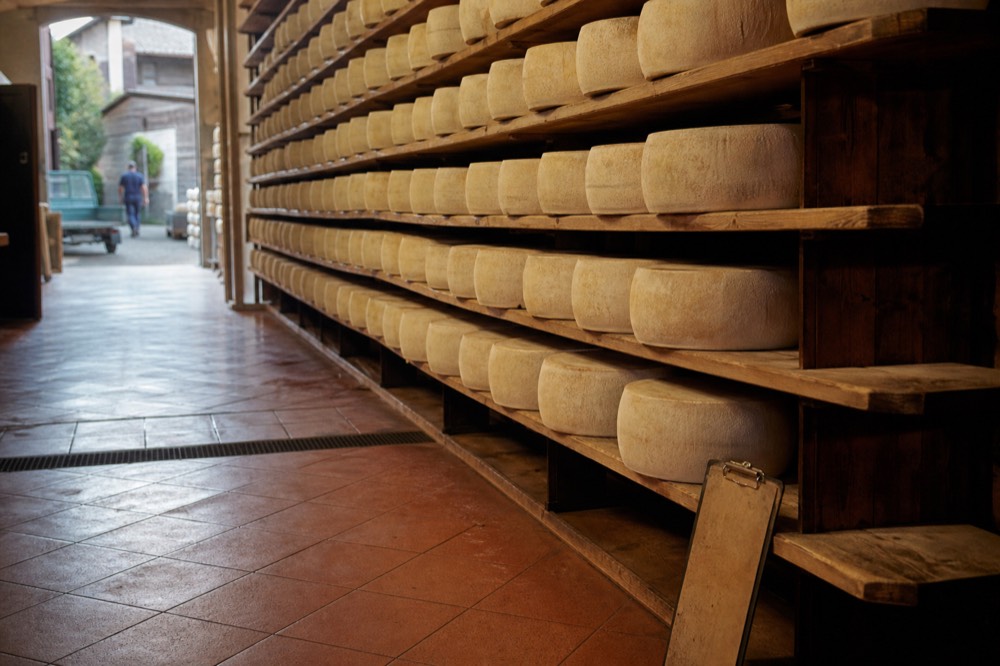
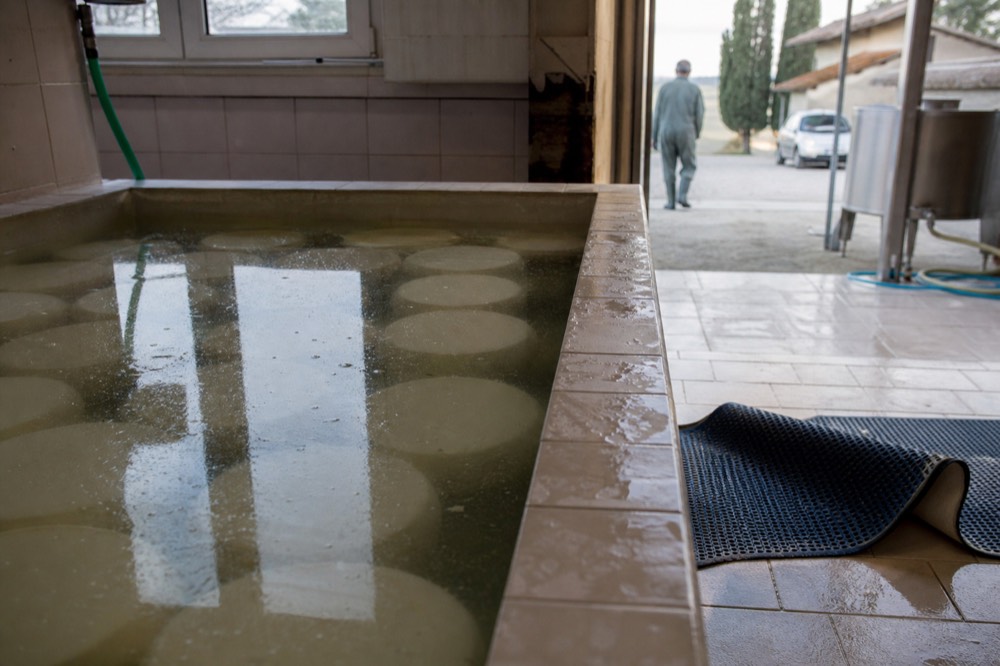
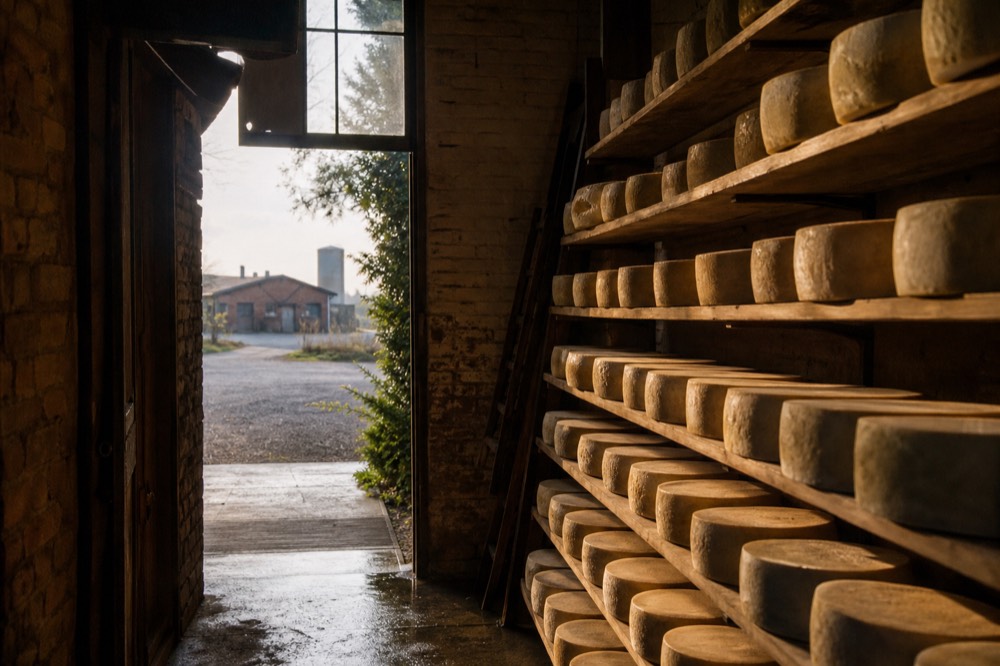
You see three rooms in sequence: the production room with the copper vats where morning milk is cooked and the curd is cut and lifted, the salting room where wheels rest in saturated brine, and the ageing warehouse, often two floors of wooden shelving holding thousands of wheels. The guide walks you through each stage, and in the ageing room you learn to read the rind: the dotted lettering that spells out the origin, and the oval fire brand applied only at 12 months to wheels that pass the hammer-tested inspection. Wheels that fail have their marks milled off and lose the right to the name.
The one thing to understand before booking is timing. Cheesemaking happens in the morning, and that is the stage worth seeing live: the vats, the steam, the splitting of the twin wheels, the wrapping in cloth. A dairy in the province states it plainly on its own visit page, 4 Madonne's guided tours page: production occurs in the morning, and afternoon tours cover that stage on video instead of live observation. Neither is a rip-off, the ageing warehouse and tasting are identical all day, but if the copper vats are the reason you are going, book a morning slot.
| Stage of the visit | What you see | When it is live |
|---|---|---|
| Production room | Copper vats, curd cutting, wheel forming in cloth moulds, casein plate stamping | Morning only; afternoons cover it on video |
| Salting room | Wheels soaking in brine basins, typically for weeks before ageing | Visible any time, the basins are permanent |
| Ageing warehouse | Wooden shelves of wheels, hammer-testing demonstration, rind marks up close | Visible any time |
| Tasting | The same cheese at multiple ages, plus young products like ricotta where offered | Any time, usually the closing 20 minutes |
The rind itself is worth your attention, because it is edible and the cheese inside it is only milk, salt and rennet, with no additives or preservatives and no rind treatment. The white crunch you taste in older cheese is tyrosine crystals, and they grow in number and size with age, so a 30-month wedge that crunches is doing exactly what it is supposed to do.
When Should You Book A Dairy Visit?
Book as soon as your travel dates are fixed, and aim for a morning slot: visits run on reservation only, the morning make is the only time the vats are live, and dairies that take walk-ins at all are the exception rather than the rule. The consortium runs its own booking page for tourist visits to dairies across the zone, which is the cleanest route if you want to choose a dairy yourself rather than through a tour operator, and it handles institutional and group visits through its Modena and Bologna section.
Season matters less than day of the week. Dairies make cheese most mornings of the week, but visit capacity is finite, small groups fill the walkway, and the visitor-ready dairies publish their calendars rather than holding open slots. There is also a calendar event worth knowing about: Caseifici Aperti, the dairies' open weekend, ran on 23 and 24 May in 2026 with 53 participating dairies, 12 of them in Modena province, offering guided visits, tastings and events, as the consortium's news page records. If your trip can be timed to the next edition, it is the cheapest and most festive way in.
| Booking route | Best for | Lead time to allow |
|---|---|---|
| Direct with the dairy | Independent travellers, exact date control | A few days to a couple of weeks |
| The consortium's visit booking page | Booking via the Consorzio's own channel | Similar; group visits need more |
| A bundled day tour with transfer | No-car travellers from Bologna or Modena | Earlier, since tour vehicles have fixed capacity |
| An open-day event like Caseifici Aperti | Families and first-timers who want a festival frame | Watch the consortium's announcements for the next edition |
One planning note that saves disappointment: the tasting is usually part of the visit, not an add-on sold separately, and allergies or intolerances must be flagged when booking, not on arrival. The standard tasting at 4 Madonne, for example, is four ages of Parmigiano Reggiano DOP plus ricotta, tosone and Parmigiano cream on bread, with balsamic, honey and preserves, wine and water, and their page asks that dietary needs be declared at reservation time.
How Much Does A Parmigiano Reggiano Factory Tour Cost?
A standalone dairy visit costs EUR 22 per adult at 4 Madonne in Lesignana, about one hour, reservation only, with EUR 12 for ages 6 to 10, free entry under 5, and EUR 14 per person for groups over 30; its Baggiovara di Modena site charges EUR 25 per adult. Those are the dairy's own published figures. Tour-listing prices on booking platforms are different numbers, under independent re-verification, so check the live listing for any bundled tour rather than relying on a figure quoted here.
The price ladder makes sense once you see what each rung buys. The bare visit is the dairy's own product. A tour with transfer adds the vehicle and the guide's travel time. A full-day tour adds a second and third producer, usually a Lambrusco cellar and a traditional acetaia, plus lunch.
| What you book | Published cost | What it includes |
|---|---|---|
| 4 Madonne visit, Lesignana | EUR 22 per adult, about 1 hour | Guided tour, tasting of four ages plus ricotta, tosone, pairings, wine and water |
| Same, ages 6-10 / under 5 / groups over 30 | EUR 12 / free / EUR 14 per person | Same visit, child and group rates |
| 4 Madonne visit, Baggiovara site | EUR 25 per adult | Same format at the second site |
| Bundled day tours with transfer and lunch | Prices on the live listing | Dairy plus further producers, transport, meal |
For context on why the cheese costs what it costs at the counter, 4 Madonne sells its mountain-certified 24-month at EUR 25.50 per kg vacuum-packed, sold direct from the dairy in a sealed format that packs easily in a suitcase for the trip home. Buying at the source is not automatically cheaper than a good shop at home, but it is the only place where you can taste before you buy and know exactly which day's make you are eating.
Can You Visit A Dairy Without A Tour Operator?
Yes, and from Modena it is genuinely easy: book direct with the dairy, ride SETA line 500 to Lesignana in 9 to 11 minutes, and you have a reservation-only visit with no operator in the middle, at the dairy's own published price rather than a bundled headline. The consortium's booking page exists precisely for this, letting you pick a dairy and request a formal visit, and the visitor-ready dairies run their own reservation calendars. From Bologna or Parma, independent visits are still possible but usually mean a rental car, since the visitor-ready dairies outside Modena are not concentrated on transit lines.
The transport picture from Modena is the best-documented on this site because it comes off SETA's own timetables. Line 500 reaches Lesignana from Modena Autostazione in 9 to 11 minutes. Do not rely on a walking time from the stop to the dairy door: that specific stretch has not been route-checked, so treat the last leg as a short walk you confirm on a map, or take the dairy's COTAMO taxi arrangement. The dairy also notes cycle paths from central Modena, which turns the trip into a flat ride of a few kilometres.
| Way in | From where | Works for |
|---|---|---|
| SETA line 500 to Lesignana | Modena Autostazione, 9 to 11 minutes | The 4 Madonne visit, car-free |
| Own car or rental | Any departure city | Any dairy in the zone, maximum flexibility |
| COTAMO taxi arrangement | Modena, arranged via the dairy | Anyone who wants the door-to-door version |
| Bundled tour vehicle | Bologna or Modena pickup | No-car travellers who want several producers in one day |
If the independent route appeals but you want a guide of your own rather than a mixed group, there is a private option in the roster worth a look: an organic dairy walked through with your own guide, timed around the morning make, tasting from young cheese to long-aged wheels. See the next available dates on the live listing if a private format fits your group better.
Which Tour Should You Pick For A Full Day?
Pick a full-day tour only if you want more than one producer in a single outing: the strong format is a dairy in the morning, a Lambrusco cellar or a traditional acetaia after, with lunch on a producer's premises, and the roster's full-day options differ mainly in where they pick you up and whether you ride or drive. A factory tour alone is a half-day experience, roughly an hour inside plus travel, so the full-day question is really a question about how much of the Food Valley you want in one ticket.
The trio below is the honest shortlist: the private organic dairy visit for depth, the full-day chauffeured version from Bologna for no-car travellers, and the Modena transfer-included visit as the lean, cheap baseline.
The Bologna-based full day deserves its own paragraph because of what it solves. Pickup in central Bologna, then a Parmigiano Reggiano dairy, a Lambrusco cellar and a traditional acetaia, with lunch on the producer premises, all without a car or a train connection to manage. For a Bologna base it removes every logistics decision except the booking itself.
The private organic format solves a different problem: it is the version where the guide is yours, the pace is yours, and the dairy is an organic operation, so the conversation can go wherever your questions lead. It is timed around the morning make, which is the part of the day worth being awake for. Check the current price before committing a whole morning to it.
One pairing note that first-time visitors often miss: a "balsamic" stop on a full-day tour means one of two very different products, Aceto Balsamico Tradizionale di Modena DOP or Aceto Balsamico di Modena IGP, and the difference is not cosmetic. The site's DOP versus IGP explainer covers it in full, and knowing it before a tasting changes what you ask for at the counter.
What Should You Know Before You Go?
Know three things: the visit is short and mostly standing, the morning is the only time the vats run, and the cheese you taste is the same cheese you can buy, so bring a bag if you intend to carry a wedge home. Beyond that, a little product knowledge converts a good visit into a great one, because the guide's explanations land harder when you already know what to look for on the rind and in the glass of the tasting.
Age is the main variable you will taste. Minimum ageing is 12 months, there is no maximum, and 24 to 36 months is the commonest age on sale. The fire brand is applied at 12 months only to wheels that pass inspection, so a branded wheel has already cleared one selection. Mountain-certified wheels, marked Prodotto di Montagna, are made and aged in the mountain zone and selected again at 20 months, with rules requiring at least 60 percent mountain-sourced dry matter in the cows' feed annually and a minimum of 12 months of mountain ageing before sale from 20 months onward.
| Detail | What to know |
|---|---|
| Rind | Edible; the cheese is only milk, salt and rennet, no additives or preservatives |
| White crunch | Tyrosine crystals, more and larger with age |
| Lactose | Naturally lactose-free at every age; lactose converts to lactic acid within 48 hours |
| Age grades | 12 months minimum, 24 to 36 the commonest sale age, no maximum |
| Mountain wheels | Prodotto di Montagna mark, second selection at 20 months |
| Dietary needs | Flag allergies and intolerances at booking, not on arrival |
Families are better catered for than the industrial setting suggests. The child rate at 4 Madonne is EUR 12 for ages 6 to 10 with under-5s free, and the consortium's broader visitor network includes dairies that host families routinely. The one-hour length suits children who can stand and watch for that span; much younger than school age and the ageing warehouse, vast and echoey, may be the highlight rather than the vats.
If the visit leaves you wanting to cook with what you bought, Modena has a strong class scene, and the site's cooking classes guide covers the home-kitchen formats where a wedge of 24-month cheese actually gets used. For the wider picture of what else to eat in the city, the what to eat in Modena guide is the companion page.
Is A Factory Tour Better Than A Shop Tasting?
A factory tour is better if you care how the cheese is made, because the shop tasting gives you the product and the dairy gives you the process, and the process is the part you cannot get anywhere else; a shop tasting is better if you only want to compare ages and buy, since it costs less and takes twenty minutes. The two are not competitors so much as different depths of the same curiosity.
The economic case for the dairy is straightforward. A good delicatessen in Modena will pour you a taste of two or three ages for the price of a purchase, and that is a fine way to spend a market morning. But the dairy visit puts the tasting at the end of an hour in which you watched the curd become a wheel, and the difference shows in the questions people ask at the counter afterwards. Visitors who have seen the casein plate stamped ask about traceability; visitors who have watched the hammer testing ask about the second selection. Nobody asks only about price.
| Factory tour | Shop or market tasting | |
|---|---|---|
| Time | About 1 hour plus travel | 15 to 30 minutes |
| What you learn | The whole process, from vat to rind | The product, by age |
| Best for | First-time visitors, families, food-motivated travellers | Quick comparison, buying decisions |
| Booking | Reservation required | None, walk in |
The site's own Mercato Albinelli guide covers the market-tasting route in detail, including the formaggerie where the cheese is cut to order, and it is the natural complement to this page for a two-part cheese day: the dairy in the morning, the market in the afternoon.
The short answers: Modena is the fastest and cheapest departure city, a standalone visit at the dairy costs EUR 22 per adult, morning slots are the only ones with live cheesemaking, and independent visits from Modena need nothing more than a reservation and a 9 to 11 minute bus ride. The questions below cover the details travellers ask most often, from child pricing to buying cheese at the source.
Common Questions About Parmigiano Reggiano Factory Tours
Which City Is Best For A Parmigiano Reggiano Factory Tour?
Modena, for most travellers. A visitor-ready dairy sits about 8 km out at Lesignana, on a bus line of 9 to 11 minutes, charging EUR 22 per adult. Bologna works well if you take a bundled tour with pickup, and Parma has the most dairies but they are spread across the province, so travel time depends on which one you book.
Can You Visit A Parmigiano Reggiano Dairy Without A Tour?
Yes. Book direct with the dairy or through the consortium's own visit booking page. From Modena, SETA line 500 reaches Lesignana in 9 to 11 minutes. From Bologna or Parma, independent visits usually mean a rental car.
What Time Of Day Should You Book?
A morning slot. Cheesemaking happens in the morning, and afternoon tours cover that stage on video instead of live. The salting room, ageing warehouse and tasting are the same all day, but the copper vats are the reason most people go.
How Long Does A Dairy Visit Last?
About one hour at the dairy itself, plus travel. The standard format is production room, salting room, ageing warehouse, then a tasting of the cheese at several ages.
Is A Dairy Visit Suitable For Children?
Generally yes. At 4 Madonne, ages 6 to 10 pay EUR 12 and under-5s are free. The one-hour standing format suits school-age children best; the ageing warehouse tends to be the highlight for younger ones.
Can You Buy Cheese At The Dairy?
Yes, and it is the one place where you taste before you buy and know the make day of the wheel. Expect producer pricing rather than a discount: 4 Madonne sells its mountain-certified 24-month at EUR 25.50 per kg vacuum-packed.