What To Eat In Modena: The Plates That Made The City Famous
Modena's food reputation rests on a handful of plates that have barely changed in a century, and on three protected products, Parmigiano Reggiano, Traditional Balsamic Vinegar and Lambrusco, that carry the city's name into kitchens worldwide. This is the plate-by-plate guide, with where each one is still done properly.
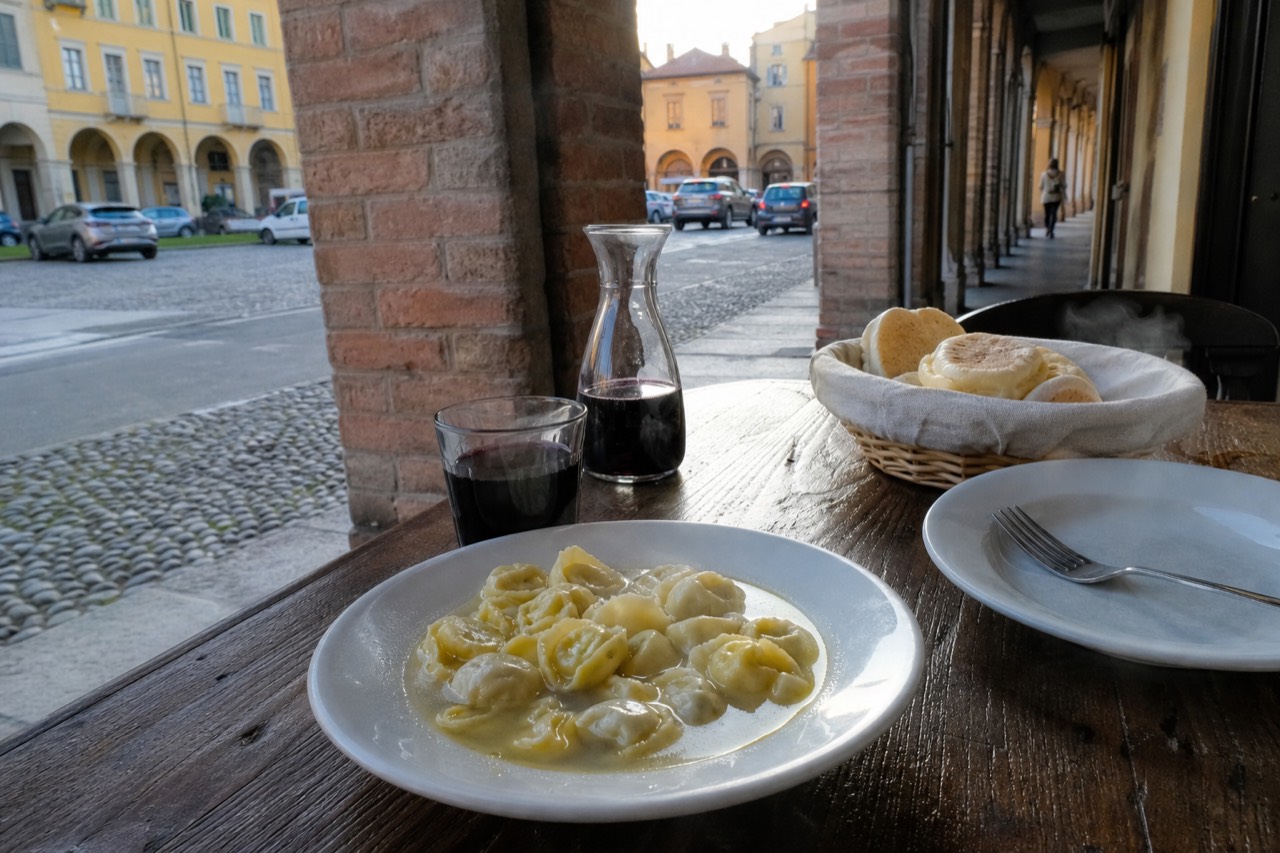
Short answer
Modena is known for tortellini in brodo, tigelle, gnocco fritto, cotechino and zampone, eaten alongside Parmigiano Reggiano DOP, Traditional Balsamic Vinegar of Modena DOP and the local Lambrusco DOC wines. The old centre and Mercato Albinelli, trading since 1931, are where most of these plates are still made the traditional way.
Modena did not become a food city by accident. Its two most famous tables, Osteria Francescana, voted The World's Best Restaurant in 2016 and again in 2018, and the market stalls that have traded since 1931, sit a few hundred metres apart, and both draw on the same small repertoire of local plates. That repertoire is what this page covers: the tortellini, the breads, the cured pork, the cheese and the wine that the province has been producing under written rules for generations.
The practical problem for a visitor is that Modena's signature dishes hide in plain sight. The names, tigelle, gnocco fritto, cotechino, sound like nothing elsewhere in Italy, and the versions served to tourists are often the laziest in town. So each section below pairs a plate with where it is still done properly, and with the drink the province actually pours beside it, which is almost always a chilled, dry-style Lambrusco (see Drinking Lambrusco). For the wider frame, our overview of Modena for food lovers covers the producer visits, and the blog answer on what food Modena is famous for gives the short version.
What Is Modena Italy Known For?
Modena is known for four things on the plate, tortellini in brodo, tigelle and crescentine, gnocco fritto, and cotechino with zampone, and three protected products beside them: Parmigiano Reggiano DOP, Traditional Balsamic Vinegar of Modena DOP, and the Lambrusco DOC wines. The city's old centre, a UNESCO World Heritage site, holds the kitchens where all of these still meet daily.
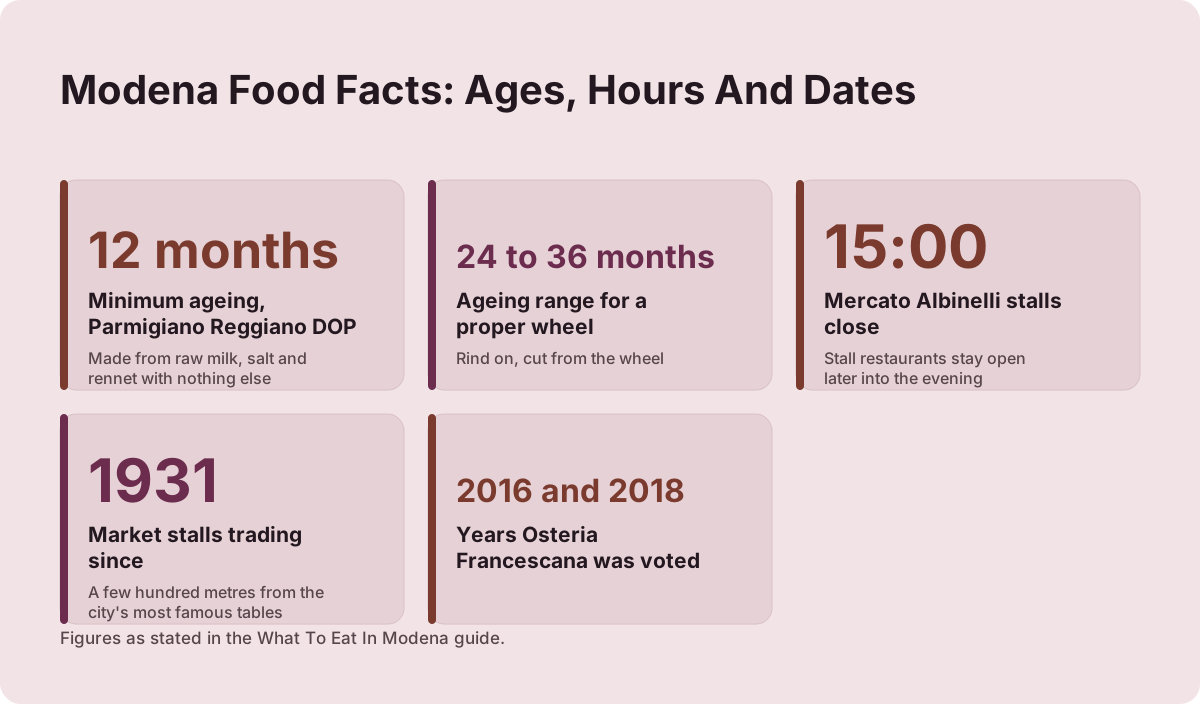
The deeper answer is that Modena is a city of rules (see Is Modena Worth It). Its famous products are governed by disciplinari, production rulebooks that specify the grape varieties, the ageing minimums and even the shape of the bottle (see Lambrusco Wine Type). Traditional Balsamic Vinegar of Modena DOP must age at least 12 years and can only be bottled inside the province, in a mandatory Giugiaro-designed flask; the rules are published in full by the DOP consortium. Parmigiano Reggiano must age a minimum of 12 months, with 24 to 36 months the commonest age on sale, and every wheel carries a traceability code stamped into its rind, as the Consorzio explains.
That rule-bound culture shapes the restaurant cooking too. A Modenese cook does not improvise a tortellino; the shape, the filling and the broth are fixed by custom, and arguing about the correct proportions is a local sport. The result for a visitor is a cuisine that rewards knowing what to order, because the canonical version of any plate is usually a short walk from a mediocre one.
| Plate or product | What it is | The version done properly |
|---|---|---|
| Tortellini in brodo | Hand-folded pasta rings in capon broth | Rolled thin by hand, served only in broth, never with cream |
| Tigelle and crescentine | Small round flatbreads from the hills | Split and filled with pesto modenese or cold cuts, served warm |
| Gnocco fritto | Pillowy fried dough squares | Eaten immediately with salumi, never as a dessert item |
| Cotechino and zampone | Slow-cooked pork sausage, plain or in pig's trotter | Traditionally with purè or lentils, especially in winter |
| Parmigiano Reggiano DOP | Hard aged cheese, milk, salt and rennet only | 24 to 36 months, rind on, cut from the wheel |
| Lambrusco DOC | Sparkling red and rosé from six denominations | Chilled, dry (secco) style, poured through the meal |
Where Do You Eat Proper Tortellini In Brodo?
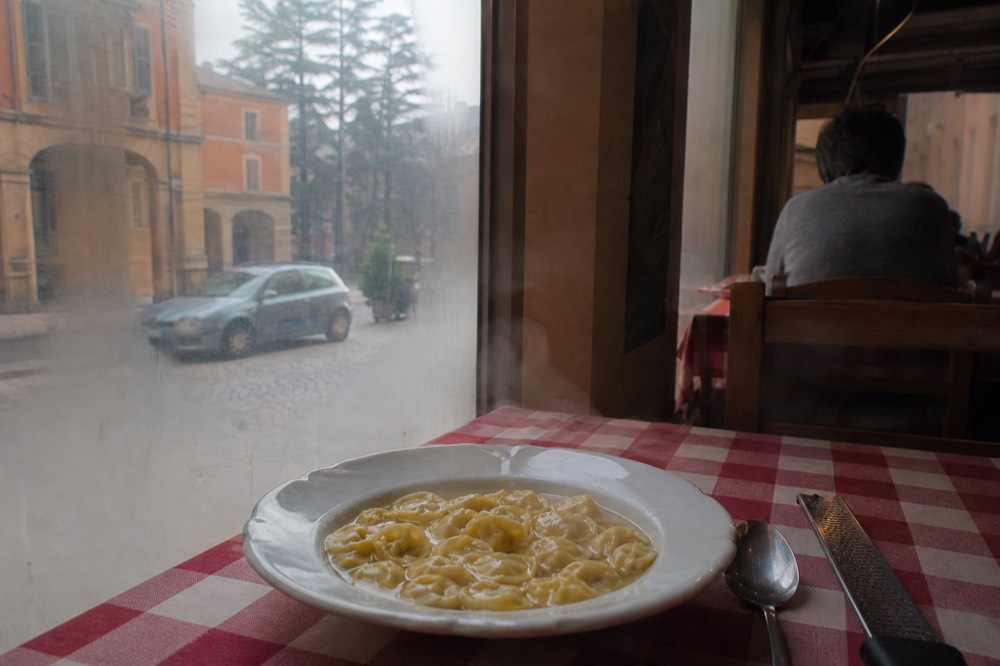
The proper version is tortellini served only in capon broth, rolled thin enough to see light through, and folded by hand into the ring shape local custom insists on. In the old centre, Hosteria Giusti and the counters of Mercato Albinelli both serve it the traditional way, and the market stalls start ladling it from late morning.
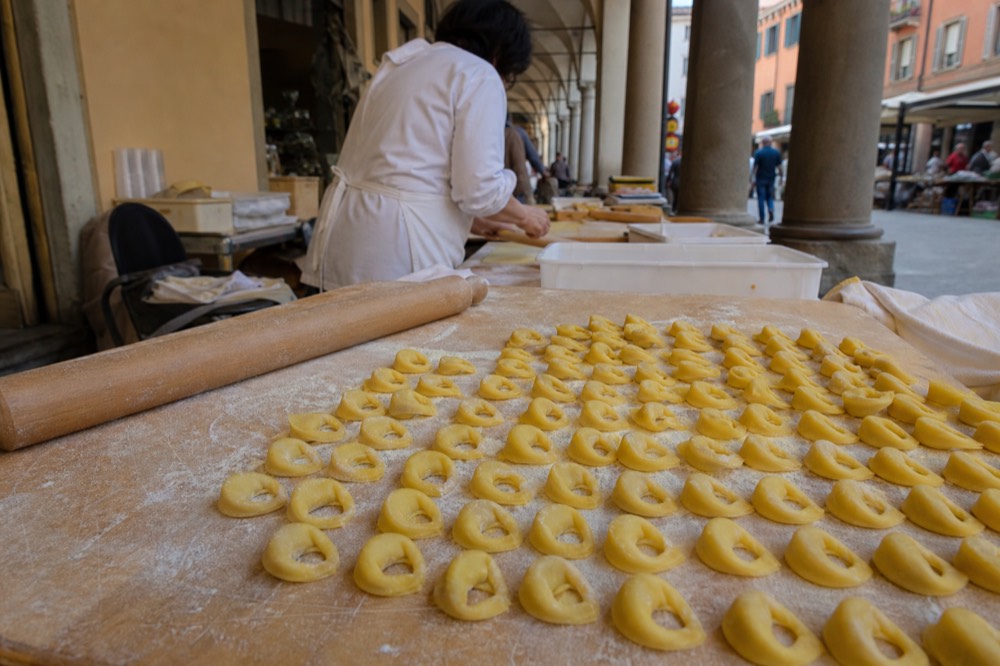
Tortellini in brodo is Modena's ceremonial dish, the one served at Christmas lunch and at wedding receptions, and the one every family claims to make best. The filling is a fixed combination of pork loin, prosciutto, Parmigiano Reggiano, egg and nutmeg, wrapped in egg pasta rolled to near-transparency. The broth is capon, sometimes with beef and hen added, and it is the whole point: the dish is a soup, not a pasta course, and any kitchen serving tortellini in brodo with cream sauce has missed the brief (see Tortellini and Broth).
Finding the real thing is easier than finding a table at the famous places. Hosteria Giusti, the tiny deli-fronted institution on Via Farini, is closed Sunday and Monday, all August, all December and the first week of January, so plan around it. Inside Mercato Albinelli, the stall counters serve tortellini in brodo through the morning while the stalls are open, which makes the market the cheapest honest version in town. The market's stalls run Monday to Saturday 07:00 to 15:00, and its restaurants keep separate, longer hours, including Sunday lunch, per the official market site.
If you want to understand the dish rather than just eat it, a walking food tour that stops at the market and the salumerie explains what a sfoglina, the pasta-rolling woman, actually does, and why the dough matters as much as the filling. Check availability for the next dates before you build your itinerary around it.
| Where | The tortellini situation | Good to know |
|---|---|---|
| Mercato Albinelli counters | Tortellini in brodo ladled at stall restaurants through the morning | Stalls close at 15:00, restaurants open later into the evening |
| Hosteria Giusti | Old-school version in a historic trattoria above a deli | Closed Sun and Mon, plus August and December |
| Franceschetta58 | Refined small plates with tortellini riffs | Closed Sunday |
| A Cesarine home class | You fold them yourself, then eat them | Host's home in Modena, address given after booking |
What Are Tigelle, Gnocco Fritto And The Breads Of Modena?
Tigelle are small round flatbreads from the Modena hills, split and filled with pesto modenese or cold cuts; gnocco fritto is pillowy fried dough eaten warm with salumi; crescentine are the baked cousin. All three are bread courses that carry cured pork, and all three are best eaten within minutes of coming off the heat.
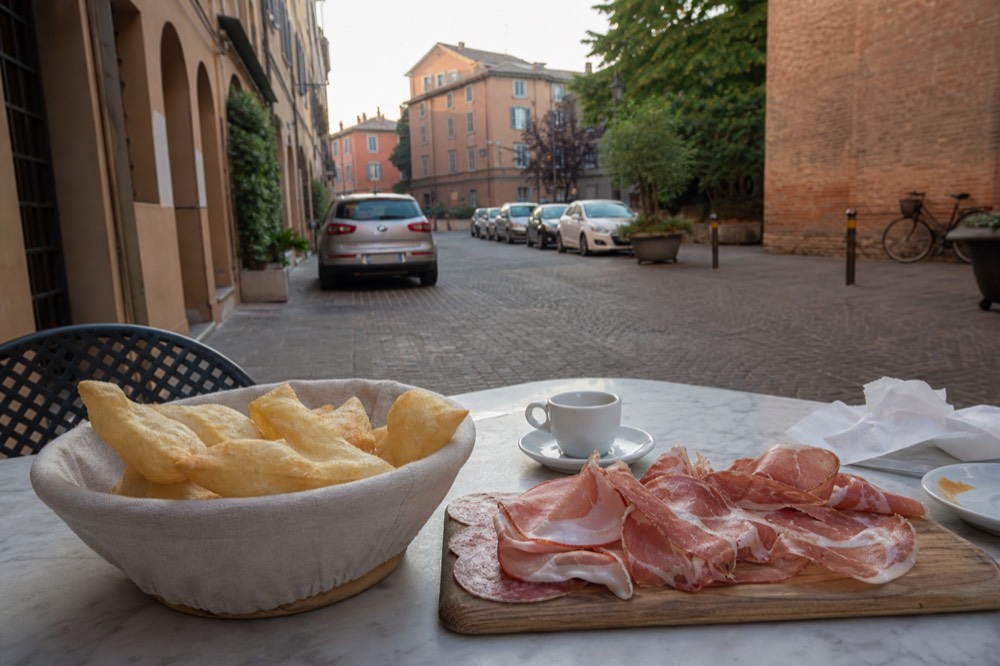
These are the dishes visitors most often miss, because they sound like side orders and are actually the heart of a Modenese appetiser course. A tigella is a disc of dough about the size of a coaster, traditionally cooked between terracotta tiles, and the classic filling is pesto modenese, a paste of lard, garlic, rosemary and Parmigiano Reggiano that has nothing to do with basil. Gnocco fritto, squares of leavened dough fried until they puff hollow, arrives in paper-lined baskets and collapses if it waits; the ritual is to tear one open, lay in a slice of culatello or mortadella and eat it while the fat is still steaming.
Inside the market, MozzaBella at Via Luigi Albinelli 13 serves gnocco fritto or focaccia as an addition to its salumi boards, and the counters around it do the same through the day. The honest generalisation about closures: days off are per venue, Sunday and Monday are the common ones, and some long-standing places shut for all of August, though the city as a whole does not.
The best way to taste all three breads in one sitting is the walk that starts on the Modenese breakfast most visitors miss, fried gnocco and coffee, before working through the market and the salumerie. See the next available dates on the live listing if that morning slot matters to your plan.
| Bread | What it is | The traditional pairing |
|---|---|---|
| Tigella | Small round flatbread, cooked between tiles | Pesto modenese, or cold cuts and soft cheese |
| Gnocco fritto | Fried leavened squares, eaten hot | Culatello, prosciutto, mortadella |
| Crescentina | Baked or fried dough, hill-country style | Salumi and stracchino |
| Borlengo | Paper-thin crêpe from the Apennine fringe | A brush of lard, garlic and cheese |
What Is Cotechino And Why Is It A Modena Institution?
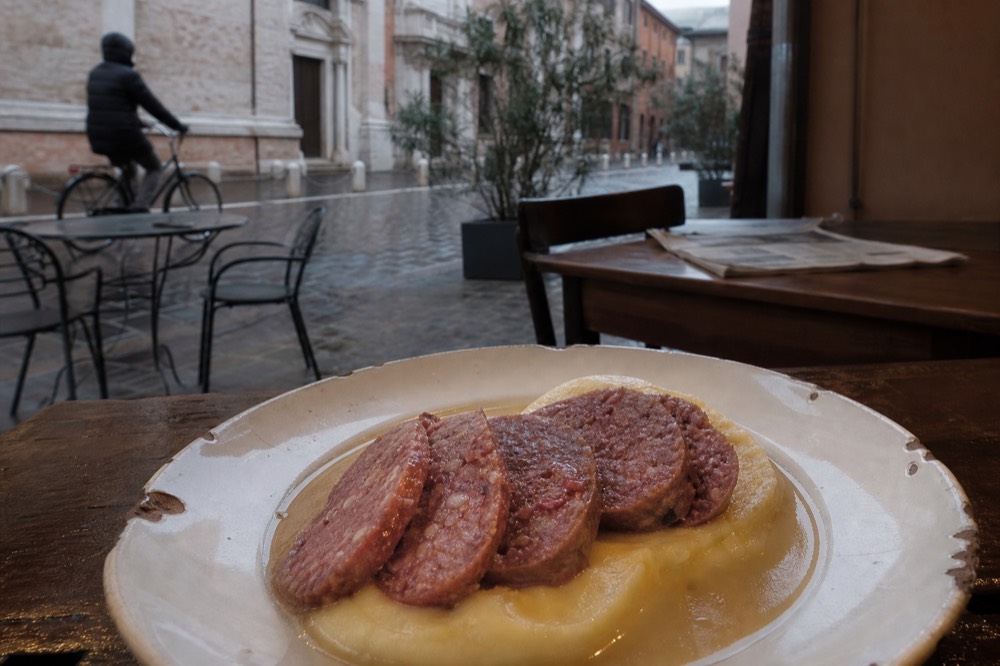
Cotechino is a soft, slow-cooked pork sausage seasoned with spice and rich in fat, and zampone is the same mixture stuffed into a boned pig's trotter. Both are Modena and Ferrara specialties with protected status, traditionally served with purè or lentils, and both anchor the New Year table.
Cotechino is winter food, dense and unapologetic, simmered for hours until it slices like a soft terrine. The Modena version, Cotechino di Modena IGP, is protected, which means the meat mix and the production zone are fixed by rule. The classic plate is cotechino with purè di patate, or with lentils on New Year's Eve, where the lentils stand for coins and the sausage for prosperity. Zampone, the trotter version, is the more theatrical presentation and appears on menus from late autumn.
Outside the festive season you will find cotechino sliced onto mixed boiled-meat plates, bollito misto, with mostarda di frutta, the candied fruit in mustard syrup that is another Modena-Bologna specialty. A full bollito misto with all seven traditional cuts is increasingly rare and worth ordering when you see it, because it is the dish that shows off the province's salumi culture in one trolley.
For most visitors the practical route into this food is a salumi board with gnocco fritto, which every serious trattoria in the centre serves, followed by a main of cotechino or bollito in season. A guided walk that ends on gelato but starts at the market counters will put the cured and slow-cooked meats in context with everything else on this page, and the current price is worth checking on the live listing before you commit an afternoon.
| Pork item | Form | When to eat it |
|---|---|---|
| Cotechino di Modena IGP | Soft spiced sausage, simmered slowly | Winter, and New Year's Eve with lentils |
| Zampone | Same mixture in a boned trotter | Festive season, from late autumn |
| Bollito misto | Seven boiled cuts with brodo and mostarda | Winter weekends at traditional trattorie |
| Culatello | The prized dry-cured heart of the leg | Any season, sliced onto gnocco fritto |
Which Lambrusco Should Sit Beside The Food?
The Lambrusco to order is a dry, secco-style bottle from one of the four Modena-province DOC denominations, Sorbara, Grasparossa di Castelvetro, Salamino di Santa Croce or Modena DOC, served chilled. Lambrusco is made across the full range from dry to sweet, and the dry style is the one poured alongside Modena food.
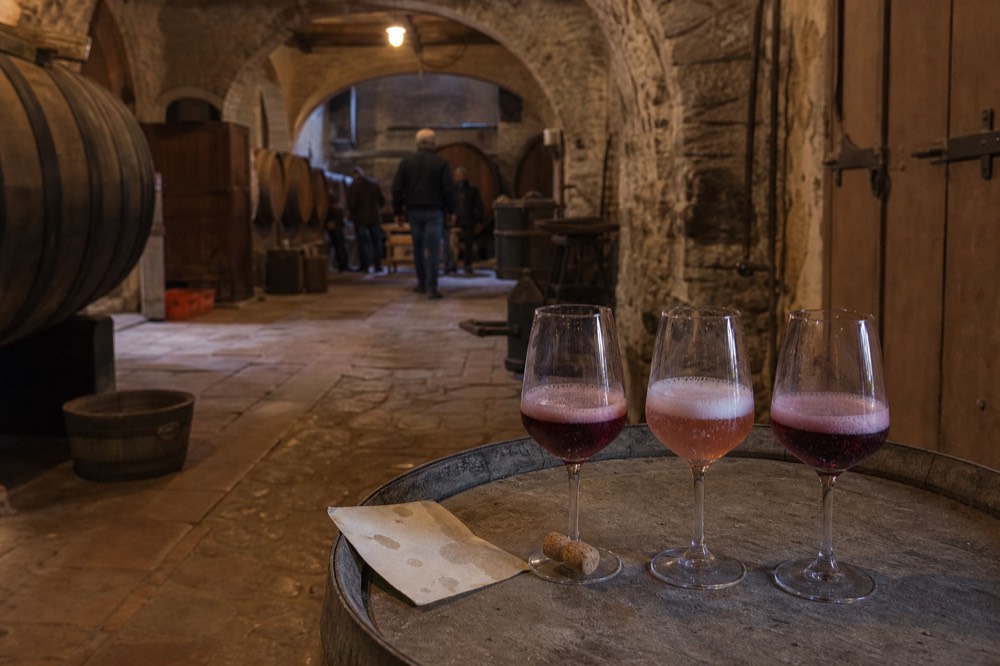
Lambrusco's export reputation as a sweet fizz does the local wine a disservice. The Consorzio Tutela Lambrusco covers six DOC denominations, four of them in Modena province, and every one of the six permits secco, semisecco, amabile and dolce versions. What the province actually pours with its own food is the secco: the pale, high-acid Sorbara beside tortellini in brodo, the darker, more tannic Grasparossa beside cotechino and grilled meats, and the medium-bodied Salamino through a whole meal. Frizzante styles, lightly sparkling rather than fully spumante, make up roughly nine bottles in every ten produced.
The styles are distinct enough that a side-by-side tasting is worth an hour, and several producers around Castelvetro and Nonantola run exactly that. Our Lambrusco tastings guide covers the cellars, including the sommelier-led tasting in Nonantola that pours three styles next to each other so the differences are obvious. If you are planning around events, the Sagra dell'Uva e del Lambrusco Grasparossa in Castelvetro runs 19 to 27 September 2026, and the hill town is reachable on SETA line 740 in 41 to 47 minutes from Modena Autostazione.
| Denomination | Character of the wine | The plate it suits |
|---|---|---|
| Lambrusco di Sorbara DOC | Pale, violet and red fruit, high acid | Tortellini in brodo, delicate fish courses |
| Grasparossa di Castelvetro DOC | Most body and tannin of the group | Cotechino, bollito misto, grilled meats |
| Salamino di Santa Croce DOC | Deep ruby, raspberry, medium body | A whole meal, salumi boards |
| Modena DOC | Central-band whites, reds and rosés | Aperitivo, tigelle and pesto modenese |
Where Does Parmigiano Reggiano Fit On The Modena Table?
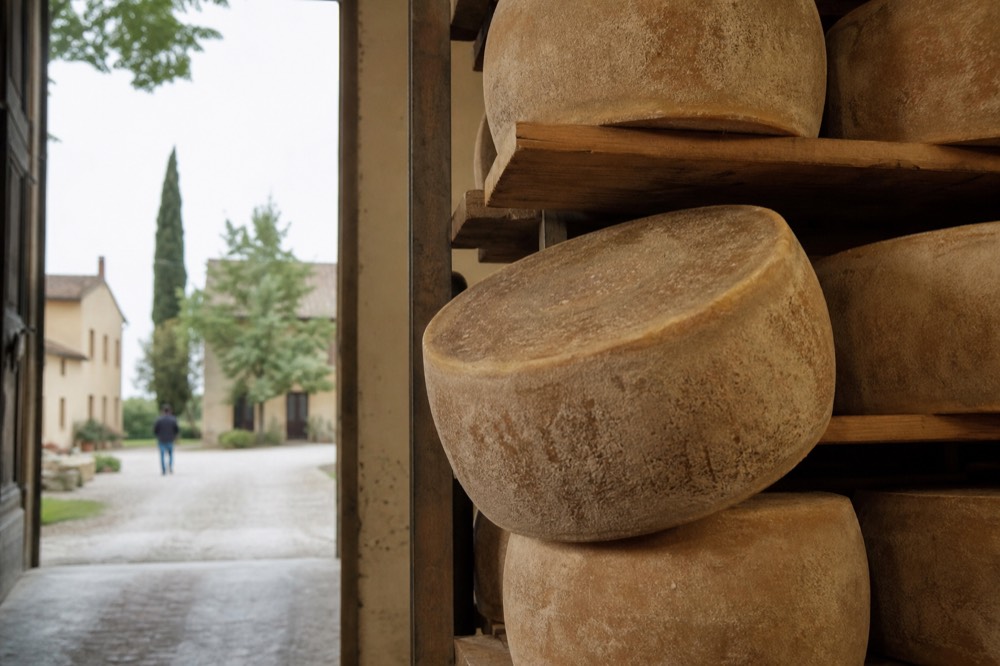
Parmigiano Reggiano DOP appears at every course of a Modenese meal: grated over tortellini in brodo, in chunks on the salumi board, and melted into the fillings of the stuffed pastas. It is made from raw milk, salt and rennet with nothing else, aged a minimum of 12 months, and its production zone includes the province of Modena.
The cheese is not a garnish here, it is infrastructure. The filling of a tortellino is built around it, the pesto modenese in a tigella depends on it, and the rind, which is edible because the cheese contains no additives or preservatives, goes into broth to deepen it. Aged wheels show the white crunch of tyrosine crystals, which grow with age, and the cheese is naturally lactose-free at every age because the lactose converts within the first 48 hours of making. The Consorzio's own pages cover all of this in plain terms.
Tasting it at different ages side by side is the fastest way to understand why the age matters, and the working dairies around Modena run visits that end with exactly that flight. Cheesemaking happens in the morning, and afternoon tours cover that stage on video instead of live, so book a morning slot if watching the vats matters to you. Our Parmigiano Reggiano tours guide lays out the options, including a dairy visit with the transfer from Modena included (see Dairy Factory Tours).
| Age of wheel | What you get | Where it lands on the table |
|---|---|---|
| 12 to 18 months | Milkier, elastic, gentler | Eating chunks, tigelle fillings |
| 24 months | The benchmark balance | Grated over tortellini in brodo |
| 36 months and over | Crystalline, intense, long finish | The end of the meal with balsamic drops |
How Do You Build A Full Modena Food Day?
A full Modena food day runs market counters in the morning, a producer visit, a dairy or an acetaia, in late morning or afternoon, and a trattoria dinner in the old centre, with Lambrusco at every stop. The walking food tours compress the market and the old-centre stops into one guided block, which is the efficient version when time is short.
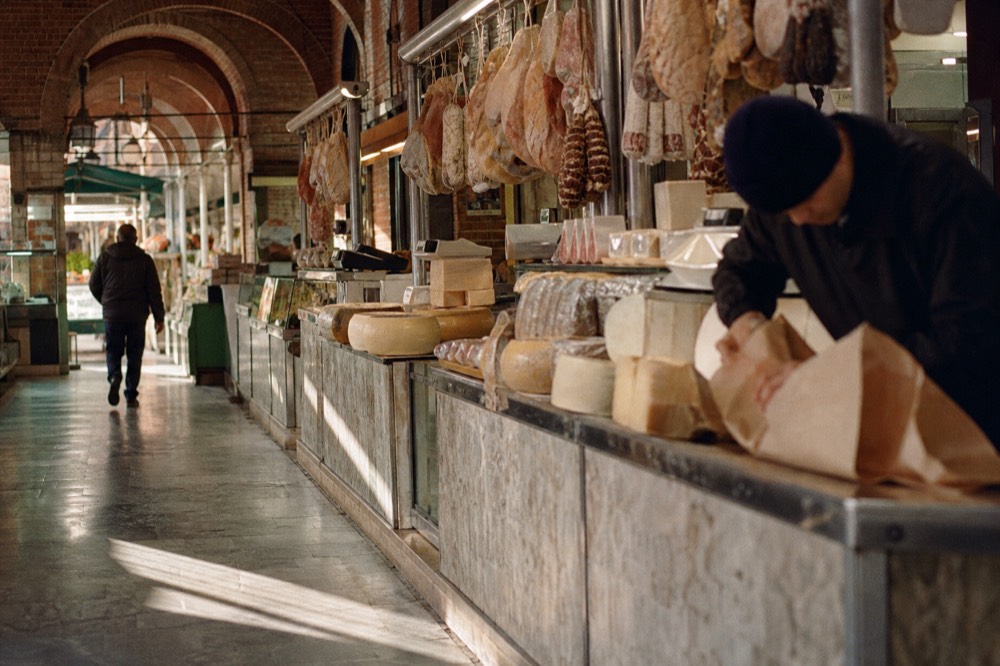
The morning belongs to Mercato Albinelli. It has traded since 1931, holds 49 stalls and 6 bars and restaurants, and its central fountain carries Giuseppe Graziosi's sculpture of a girl with a basket of fruit. The stalls open at 07:00 and close at 15:00 Monday to Saturday, with winter Saturdays extending to 19:00, and the restaurants open seven days including Sunday, 12:00 to 15:00 and 18:30 to 23:00. A coffee and a fried gnocco at a market bar, then a lap of the formaggerie and salumerie, is how the city does breakfast.
The afternoon splits by interest. The balsamic angle means an acetaia: the traditional vinegar ages at least 12 years in graded barrel batteries, and the DOP consortium's own FAQ notes that the tasting on a booked acetaia visit is free, with acetaie chosen from its interactive map. The cheese angle means a dairy, booked ahead, morning for the live make. The city walk that also takes you inside a working acetaia rather than tasting balsamic at a counter is the one tour format that stitches both halves of the day together, so check the current price before you plan around it.
What Should You Not Miss If You Only Have One Day?
If you have one day, do not miss tortellini in brodo at a market counter or a traditional trattoria, a tigella split and filled with pesto modenese, gnocco fritto with culatello, a tasting of Traditional Balsamic Vinegar of Modena DOP at an acetaia, and a chilled secco Lambrusco beside all of it. That single day contains the whole argument for Modena as a food capital.
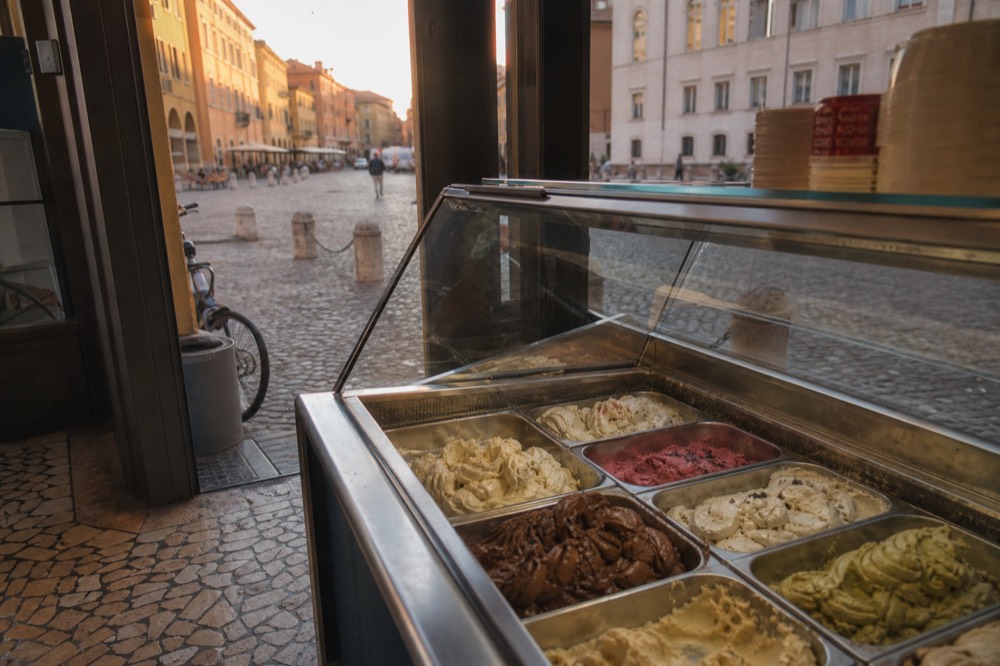
Order in that order and the day builds sensibly: the breads and salumi as an aperitivo, the tortellini as the centrepiece, the balsamic as the bridge between savoury and sweet, and the gelato, which Modena takes seriously, to finish. Two things catch visitors out. First, closing days are per venue, with Sunday and Monday the common ones, so check the individual restaurant before you walk across town. Second, the historic centre sits inside a ZTL with camera control, so arrive on foot, by taxi or with parking outside the restricted streets rather than driving to the door.
For travellers who want the plates explained rather than just served, the shortest of the city walks covers Piazza Grande, the Ghirlandina tower, Acetaia Giusti and Mercato Albinelli with a tasting at each stop, which is the whole itinerary above in guided form. See the next available dates on the live listing.
The honest summary is that Modena rewards a short list done properly. The city's kitchens, as this site, Food Tours in Modena, exists to document, have spent centuries refining a small number of plates, and the protected products that carry its name are made within an hour of the table they end up on. Order the canonical versions, ask what is in season, and pour the local wine.
The questions below cover the short answers to what to eat in Modena: what the city is known for, where the proper tortellini in brodo is served, what tigelle and gnocco fritto actually are, which Lambrusco style to order, what cotechino is, and whether Parmigiano Reggiano comes from Modena at all. Each answer is drawn from the sections above and kept to the essentials you need at the table.
Common Questions About What To Eat In Modena
What Is Modena Italy Known For?
Tortellini in brodo, tigelle, gnocco fritto, cotechino and zampone, alongside Parmigiano Reggiano DOP, Traditional Balsamic Vinegar of Modena DOP and the Lambrusco DOC wines. The old centre and the covered market, trading since 1931, are where most of these plates are still made the traditional way.
Where Do You Eat Proper Tortellini In Brodo?
At the counters of Mercato Albinelli through the morning, or at a traditional trattoria in the old centre such as Hosteria Giusti, which is closed Sunday and Monday plus August and December. The proper version is served only in capon broth, never with cream.
What Are Tigelle And Gnocco Fritto?
Tigelle are small round flatbreads from the Modena hills, split and filled with pesto modenese or cold cuts. Gnocco fritto is fried leavened dough eaten warm with salumi. Both are bread courses, best eaten within minutes of cooking.
Which Lambrusco Should You Drink In Modena?
A chilled, dry, secco-style bottle from one of the four Modena-province DOC denominations: Sorbara, Grasparossa di Castelvetro, Salamino di Santa Croce or Modena DOC. Lambrusco is made across the full range from dry to sweet, and the dry style is what gets poured alongside Modena food.
What Is Cotechino?
A soft, slow-cooked spiced pork sausage with protected IGP status in its Modena version, traditionally served with potato purée or lentils, especially around New Year. Zampone is the same mixture stuffed into a boned pig's trotter.
Is Parmigiano Reggiano From Modena?
Yes. The production zone covers the provinces of Parma, Reggio Emilia, Modena, Bologna left of the Reno and Mantova right of the Po, so Modena is one of the core provinces. The cheese is made from raw milk, salt and rennet with nothing else, and aged a minimum of 12 months.