Parmigiano Reggiano Tours From Modena: What A Dairy Visit Actually Gets You
Parmigiano Reggiano is made in the morning, in a production zone that includes the whole province of Modena, and the dairies around the city take visitors by reservation. This guide covers what a caseificio visit actually includes, why timing matters, and how to fold one into a wider food day.
Short answer
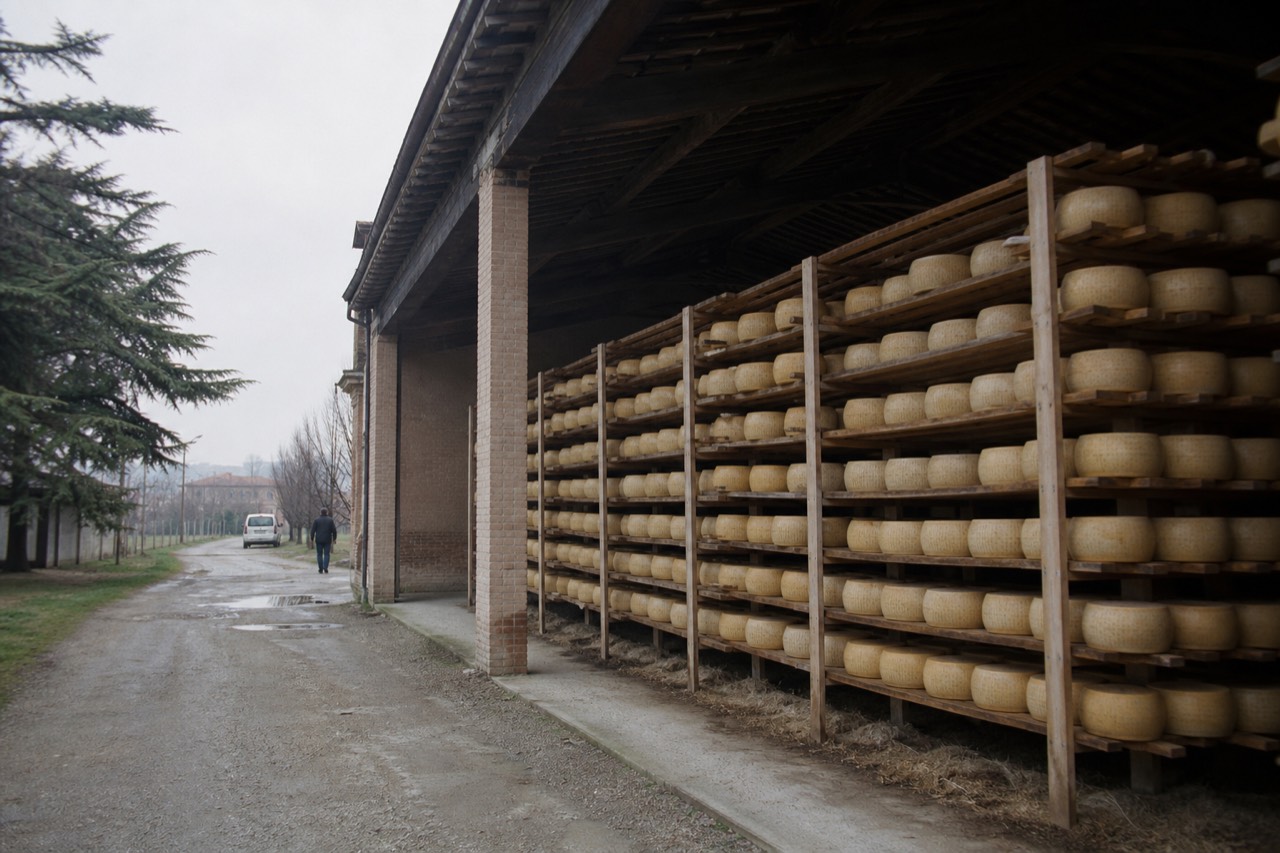
Parmigiano Reggiano tours from Modena take you inside a working caseificio: the copper vats, the salting room and the ageing shelves, with a tasting of the same cheese at different ages. The make happens in the morning, so morning slots show it live. The 4 Madonne dairy at Lesignana charges EUR 22 per adult and runs visits daily by reservation.
Every wheel of Parmigiano Reggiano carries a casein plate with a unique alphanumeric code, the letters CFPR and a Datamatrix mark, so the cheese can be traced back to the day it was made and the dairy that made it (see Parmigiano vs Parmesan). That traceability is not marketing. It is the mechanism the Consorzio del Parmigiano Reggiano uses to guarantee that what you buy is exactly what the name promises, and it is one of the reasons a dairy visit around Modena is a different kind of food tour: you are watching a regulated production process, not a demonstration staged for visitors.
Modena sits inside the DOP production zone, which covers the provinces of Parma, Reggio Emilia, Modena, Bologna left of the river Reno, and Mantova right of the Po (see Parma or Modena). Milk, cheesemaking, the minimum ageing and the packing all have to happen inside that zone. This guide covers the dairy visits that actually run out of Modena, the timing question that matters more than most visitors expect, and how a caseificio stop pairs with a balsamic visit on the same day.
What Does A Parmigiano Reggiano Tour Include?
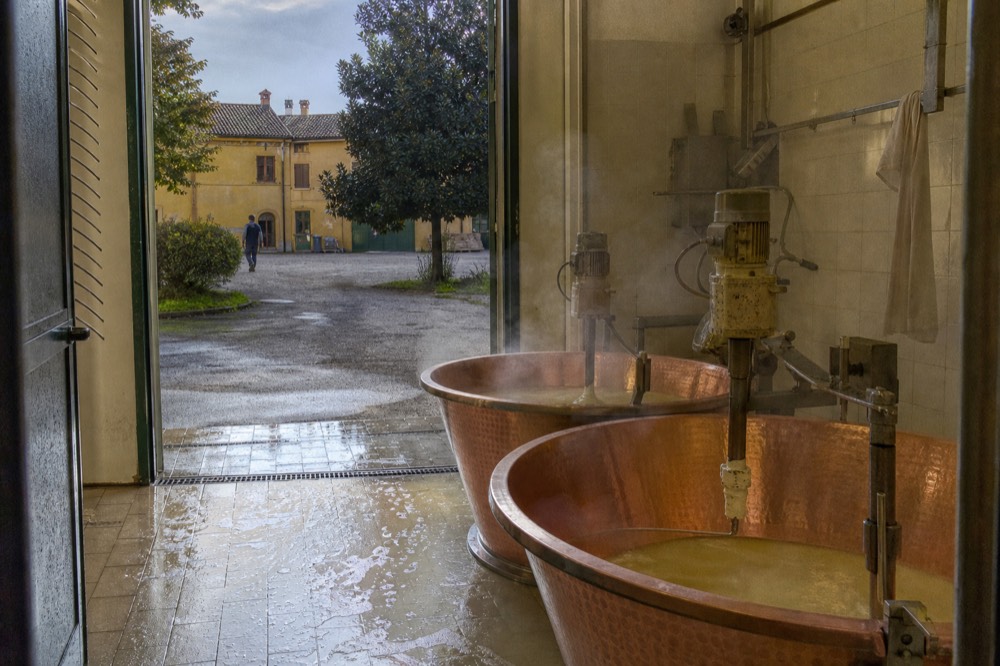
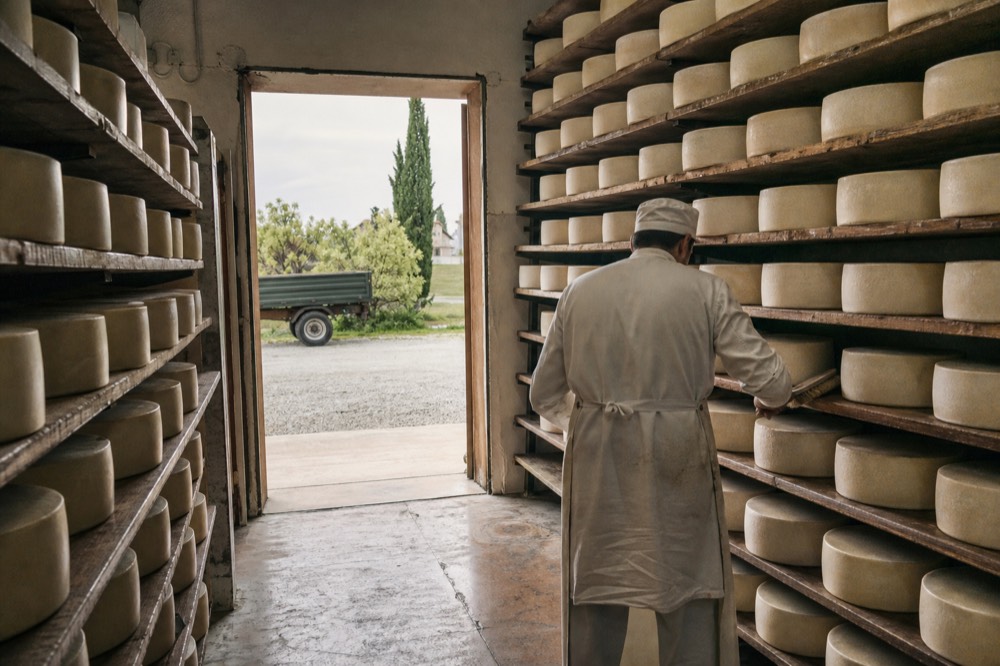
A Parmigiano Reggiano tour is a guided walk through a working dairy: the copper vats where curd is cut and cooked, the moulding benches where the wheels are formed, the brine bath and salting room, and the ageing warehouse with its stacked shelves, ending with a tasting of the same cheese at several ages. Visits are by reservation only and last about an hour before the tasting, so book ahead.
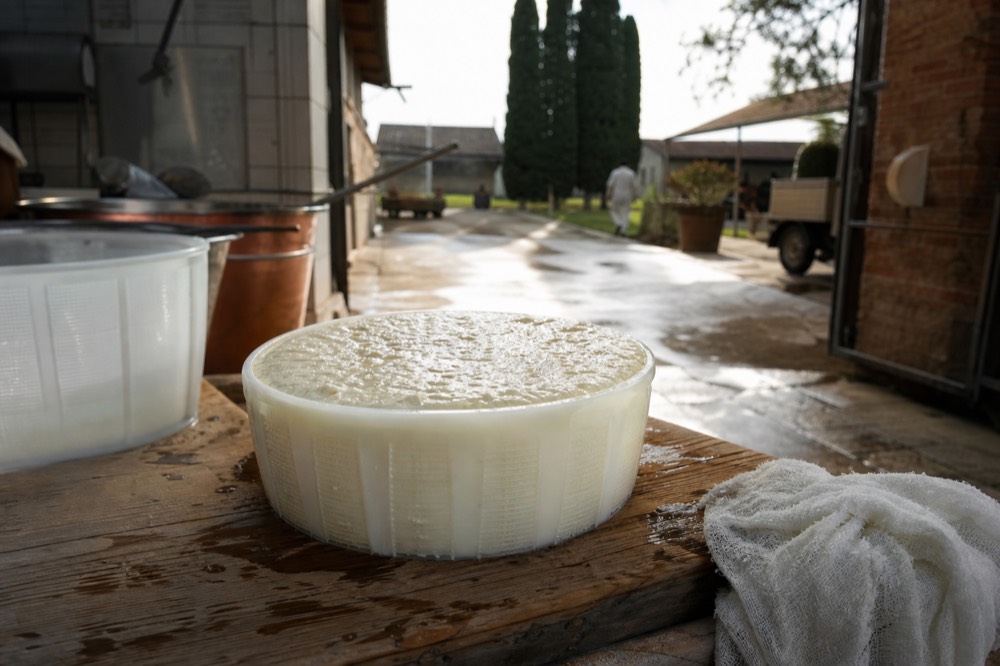
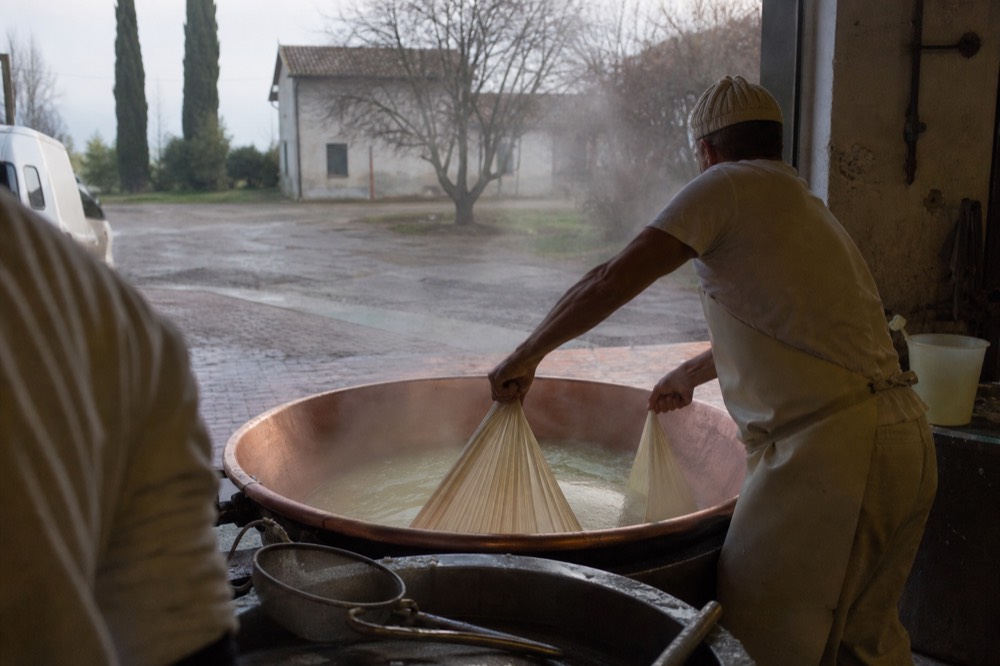
The core of the visit is the same at almost every caseificio because the process is fixed by the disciplinare. The milk arrives from farms in the zone, the curd is broken up and cooked in copper vats, the mass is lifted out in a cloth and split into the moulds that give the wheel its shape, and the rind is stamped with the origin marks in the wheel's first hours. Then comes the salting, and then the long wait in the ageing room.
What varies between dairies is the framing. Some visits are run by the dairy's own staff and stay tightly technical. Others, including several of the bookable tours from Modena, add a transfer from the city, a longer tasting flight, or a guide who walks you through the marks on the rind so you can read a wheel yourself afterwards. The Consorzio runs its own booking page for tourist visits to dairies, and individual caseifici take reservations directly; the Consorzio's site explains both routes.
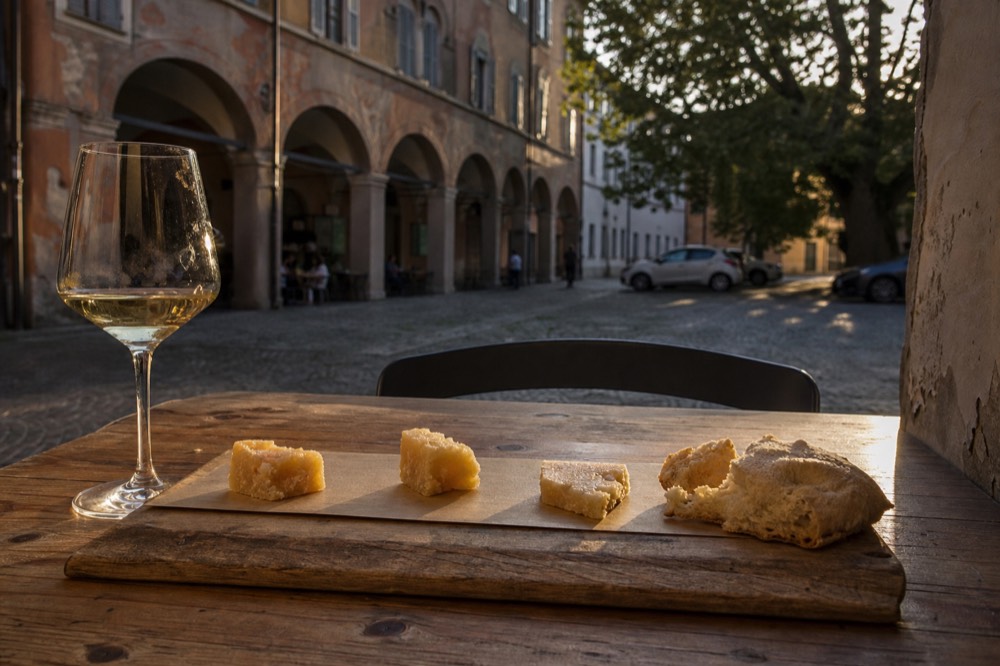
The tasting is where the visit pays off. A standard flight puts the same cheese at different ages side by side, typically from a young wheel to a long-aged one, so you can taste the texture tighten and the flavour deepen. At 4 Madonne, the standard tasting is four ages of Parmigiano Reggiano DOP plus ricotta, tosone and Parmigiano cream on bread, with balsamic, honey and preserves, wine and water included.
| Stage of the visit | What you actually see | What it tells you |
|---|---|---|
| Copper vats | Curd cut and cooked, whey separating | Where the cheese physically begins |
| Moulding benches | The wheel shaped in its mould, rind stamps applied | How traceability starts in the first hours |
| Salting room | Wheels in brine baths or dry salting | The only step besides milk, rennet and salt |
| Ageing warehouse | Stacked shelves, wheels turned and brushed | The 12-month minimum and the hammer inspection |
| Tasting | The same cheese at several ages | What age actually does to flavour |
If you are choosing between formats, the deciding factors are transport and timing rather than content. Some visitors prefer a self-drive or public-transport visit booked straight with a dairy; others want the transfer, the guide and the tasting bundled. Our guide to the factory-tour question, Parma versus Bologna versus Modena breaks down that choice by base city.
Which Parmigiano Reggiano Tours Run Out Of Modena?
The Modena-based options fall into three groups: a dairy visit with transfer from the city included, a private visit at an organic caseificio timed around the morning make, and combination days that pair the dairy with a balsamic acetaia and sometimes a Lambrusco cellar. All three reach working dairies within roughly 15 to 30 minutes of the city. The differences are format, group size and how much of the day they fill.
The simplest format is the half-day visit with transfer. You are collected in Modena, taken to a working dairy about 15 minutes out, walked through the vats, the salting room and the ageing shelves, and then given a tasting flight of the same cheese at different ages before being returned to the city (see Is Modena Worth It). This is the format most first-time visitors want, and it is the one that sells the morning slots first, because the morning slots are the ones where the make is happening live.
The second format is the private visit. Caseificio Bio Reggiani, an organic dairy in the Castelfranco Emilia area, runs a private walk with your own guide, timed around the morning make, tasting from young cheese up to long-aged wheels. Private formats cost more per person but give you the room to ask questions, and they matter more here than in many tour categories because cheesemaking is fast, physical and easy to miss if you are at the back of a group.
The third format is the combination day. The classic pairing is a dairy in the morning followed by the barrel loft of a family acetaia, which is the itinerary the parmigiano and traditional balsamic day format follows, and there are longer versions that add a Lambrusco cellar and lunch on the producer's premises. There is also a full-day format that starts from Bologna rather than Modena, which suits visitors basing themselves there.
Whichever format you lean toward, check the current price on the operator's live listing before you plan the day, because the bundled formats and the private formats sit at very different points on the cost curve and the listing carries the exact figure.
| Format | Typical length | Who it suits | Trade-off |
|---|---|---|---|
| Dairy visit with transfer | Half day | First-time visitors, no car | Fixed group schedule |
| Private organic dairy visit | Half day, private | Families, cheese-interested travellers | Higher per-person cost |
| Dairy plus acetaia day | Most of the day | Visitors wanting the two flagship products | Longer commitment |
| Dairy, wine and lunch day | Full day | Visitors with a full day to spend | Earliest start, furthest reach |
Why Does The Timing Of The Make Matter So Much?
Cheesemaking at a Parmigiano Reggiano dairy happens in the morning, and afternoon tours cover that stage on video rather than live. A morning slot shows the vats working, the curd lifted and the wheels stamped in real time; an afternoon slot shows everything else, the salting room and the ageing warehouse, in person. Both are real visits, but only one shows the make.
This is the single most useful thing to know when booking, and it comes straight from the dairies. 4 Madonne Caseificio dell'Emilia at Lesignana states it plainly on its own visits page: production occurs in the morning, and afternoon tours explain the process via video instead of live observation. Other dairies in the zone follow the same rhythm, because the milk schedule sets it.
The practical consequence is that morning slots book out first. If seeing the copper vats in action matters to you, book the earliest slot available and book it ahead. If you would rather sleep in, an afternoon visit is still worth doing, the ageing warehouse alone is a genuinely impressive space, but go in knowing that the make itself will be on a screen.
There is a second timing layer: the make is not a continuous process you can drop in on at any point. It is a sequence. The curd is cut and cooked, the mass is lifted and divided, and the new wheels get their stamps in their first hours. Arrive late in the sequence and you see the moulding and salting but not the vats. This is why tour operators with fixed morning departures are popular: they time the arrival to the sequence rather than leaving it to you.
| Slot | The vats | The salting room | The ageing warehouse | Best for |
|---|---|---|---|---|
| Early morning | Live, full sequence | Live | Live | Seeing the whole make |
| Mid-morning | Tail end of the make | Live | Live | Compromise on start time |
| Afternoon | On video | Live | Live | Late risers, relaxed pace |
One more timing note: dairies are working farms and food producers, not museums, so visits run by reservation only even on quiet days. The Consorzio's booking service and the individual dairy pages both make this explicit. See the next available dates on the listing you are considering before you lock the rest of your itinerary around it.
How Do You Read A Wheel After The Visit?
A Parmigiano Reggiano wheel carries two marks: the dotted lettering around the rind, which is the origin mark applied when the wheel is formed, and the oval fire brand reading Consorzio Tutela Parmigiano-Reggiano plus the production year, applied at 12 months only to wheels that pass the hammer-tested inspection. Wheels that fail have the origin marks milled off and lose the right to the name.
This is the part of a dairy visit that changes how you shop for the rest of your life. The Consorzio's guide to the marks lays it out, and a good guide on the visit walks you through it on a real wheel. The casein plate inside the rind carries the unique code, the CFPR letters and the Datamatrix, which is what lets a wheel be traced to its day and its dairy.
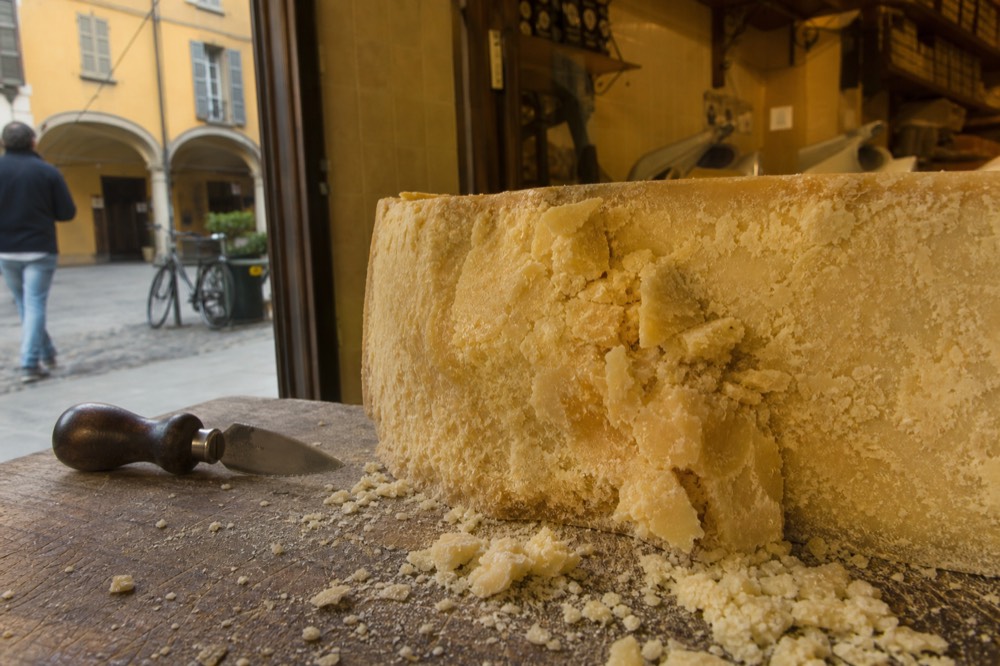
Ageing is the other thing you learn to read. The minimum is 12 months, and there is no maximum; 24 to 36 months is the commonest age on sale. The white crunch you find in older cheese is tyrosine crystals, and they grow in number and size with age, so a wheel with more crunch is usually an older wheel. The rind is edible, because the cheese is only milk, salt and rennet, with no additives or preservatives and no rind treatment. And Parmigiano Reggiano is naturally lactose-free at every age, because the lactose converts to lactic acid within the first 48 hours.
There is also a mountain tier. Prodotto di Montagna wheels are made and aged in the mountain zone and selected again at 20 months, with over 110 mountain dairies and over 1,200 mountain farmers involved across Parma, Reggio Emilia, Modena and Bologna (see Via Emilia). If a visit mentions mountain wheels, that is what it means: a second, stricter selection, not a different cheese.
| Mark or feature | Where it is | What it proves |
|---|---|---|
| Dotted lettering | Around the rind | Origin: the wheel was made in the zone |
| Oval fire brand | On the rind | Passed the 12-month hammer inspection |
| Casein plate with CFPR | Inside the rind | Traceable to the day and the dairy |
| Tyrosine crystals | In the paste | Age: they grow with time |
How Much Does A Dairy Visit Cost?
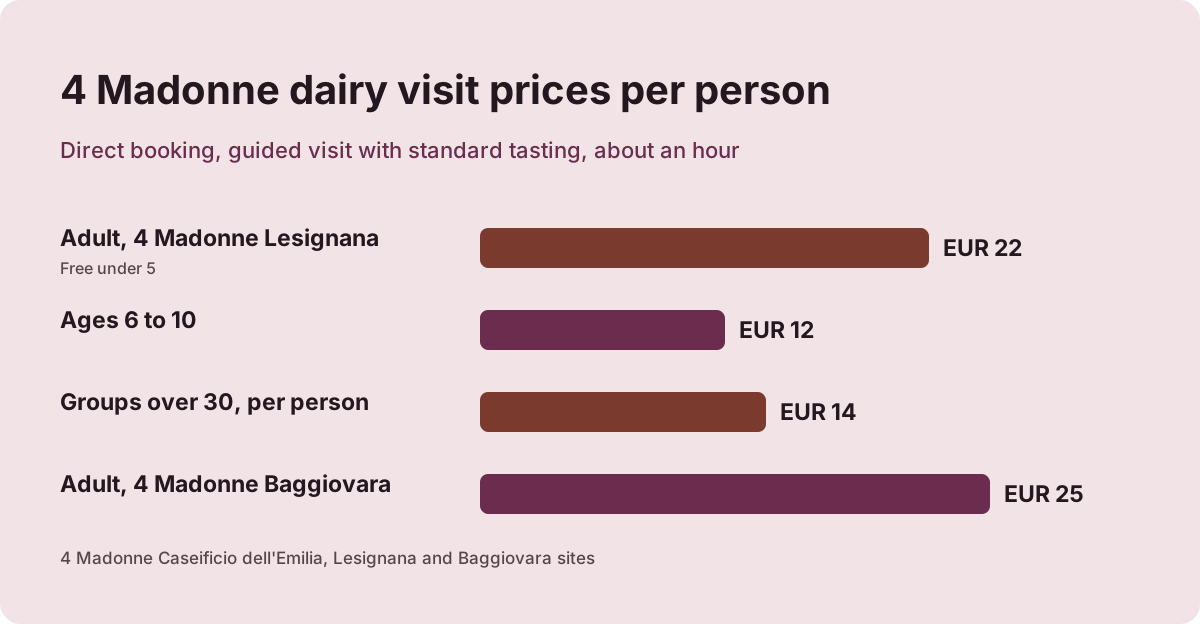
Direct with the 4 Madonne dairy at Lesignana, a guided visit costs EUR 22 per adult, EUR 12 for ages 6 to 10, free under 5, and EUR 14 per person for groups over 30, lasting about an hour with the standard tasting included; its Baggiovara site charges EUR 25 per adult. Booked tour formats with transfer and guide from Modena cost more, and their current prices are on the live listings.
The direct-booking figures are worth knowing because they set the floor. What the tour formats add is the transfer, the guide's commentary in your language, and in some cases a longer tasting or a second stop. Whether that premium is worth paying depends mostly on whether you have a car and whether you want the producer's own staff to run the whole thing or a guide who can bridge between stops.
For context on what you are paying to see: every stage, from the milk arriving to the packing of the finished wheels, has to happen inside the DOP zone, and no wheel earns the name until it passes the inspection at 12 months. A dairy visit puts you inside that system. A dairy visit puts you inside one small piece of that system on the day a wheel is born.
| Booking route | Adult price | What is included | Notes |
|---|---|---|---|
| Direct, 4 Madonne Lesignana | EUR 22 | About 1-hour visit, standard tasting of four ages plus pairings | Reservation only, daily |
| Direct, 4 Madonne Baggiovara | EUR 25 | Same format at the second site | Reservation only |
| Tour with transfer from Modena | On the listing | Transfer, guide, visit, tasting | Morning slots sell first |
| Private organic dairy visit | On the listing | Private guide, organic dairy, timed to the morning make | Check the live price |
If you are weighing a dairy visit against other food experiences in the city, our Modena food tour prices guide puts the main categories side by side.
Can You Pair A Dairy Visit With Balsamic On The Same Day?
Yes, and it is the natural Modena pairing: the dairy make happens in the morning and finishes by late morning, which leaves the afternoon free for a balsamic acetaia visit, and several combination tours run exactly that itinerary with both stops explained by the people who run them. The pairing works geographically too, since acetaie sit across the same province.
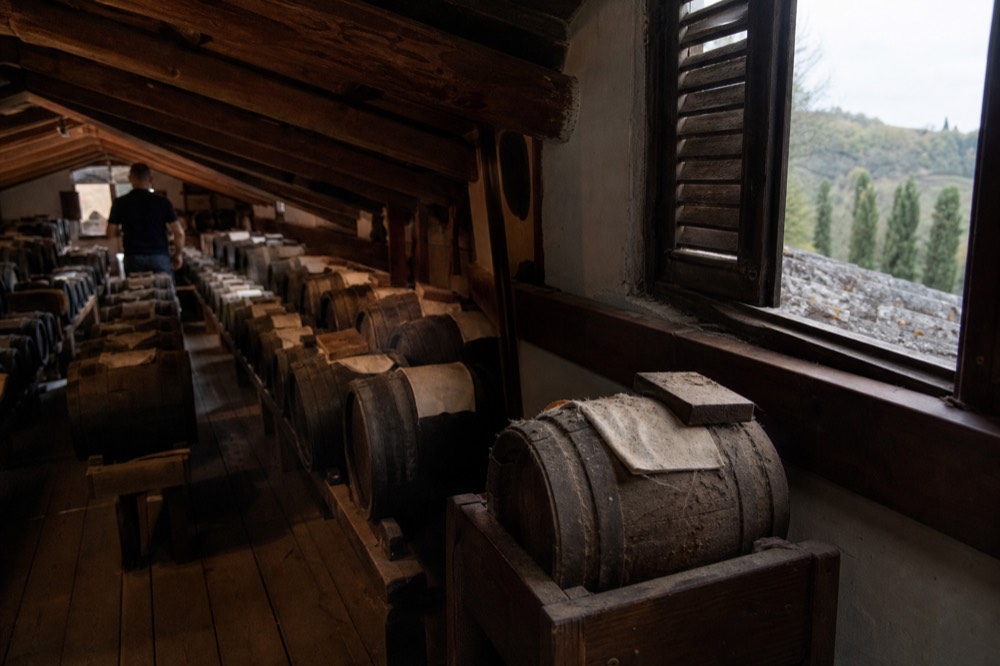
The logic of the day is set by the dairy's clock. Because the make is a morning event, a dairy-first day uses your morning well and hands you an afternoon. An acetaia visit fills it perfectly: barrel lofts are not tied to a production moment in the same way, since the ageing in a batteria of small barrels runs for years, so the visit is about explanation and tasting rather than catching a process live.
The combination format that does both in one booked day visits a working dairy in the morning and then the barrel loft of a family acetaia, with both stops run by the producers themselves. It is the cleanest way to do the pairing without a car, and it is the format we would point most visitors toward if the two flagship products are both on the list.
If you build the day yourself, keep the distinction between the two balsamic products in mind. Aceto Balsamico Tradizionale di Modena DOP is cooked grape must alone, aged a minimum of 12 years, with two grades only: the 12-year Affinato and the Extra Vecchio at a minimum of 25 years. Aceto Balsamico di Modena IGP is a different product, cooked and concentrated must with at least 10% wine vinegar added and a minimum of 60 days in wood. Our DOP versus IGP explainer covers the difference in full, and the DOP consortium's own pages set out the ageing minimums and the numbered seal.
| Day plan | Morning | Afternoon | Suits |
|---|---|---|---|
| Booked combination day | Working dairy, live make | Family acetaia barrel loft | No-car visitors, first-timers |
| Self-built, with car | Dairy booked direct | Acetaia booked direct | Independent travellers |
| Full food-and-motors day | Dairy, then Ferrari museum | Acetaia with lunch, Lambrusco | Visitors wanting both valleys |
For visitors with a full day and a wider appetite, there are formats that add a Lambrusco cellar and lunch on the producer's premises, and a full-day version that adds the Ferrari museum at Maranello to the same spine (see Maranello Worth It?). Our Ferrari and food tours guide covers that combination in detail.
How Do You Get To A Dairy Without A Car?
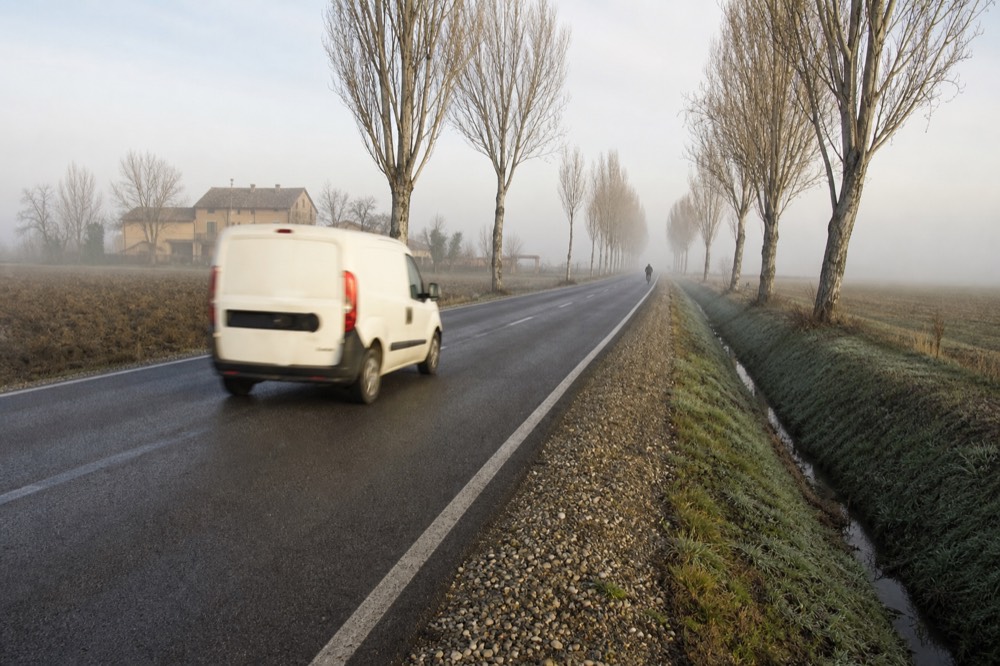
Most booked Parmigiano Reggiano tours from Modena include the transfer, which is the easiest route. Independently, SETA bus line 500 reaches Lesignana, where the 4 Madonne dairy is, from Modena Autostazione in 9 to 11 minutes, and the dairy itself lists Modena station at about 8 km with a taxi arrangement and cycle paths from the centre.
The public-transport picture is workable but needs honesty. Line 500 (Carpi-Soliera-Lesignana-Modena) stops at Lesignana, and the ride from the Autostazione is short. What we do not publish is a walking time from the stop to the dairy, because that stretch has not been route-checked; the dairy's own page gives its distances by rail and mentions a COTAMO taxi agreement for transfers to its address at Strada Lesignana 130, plus cycle paths from central Modena.
For dairies further afield, the arithmetic changes. The production zone stretches across five provinces, and some of the best-known caseifici sit closer to Parma than to Modena. If a specific dairy is your goal, check its location against the bus network before assuming it is a Modena day trip; the SETA line list is published at setaweb.it.
The transfer-included tours exist precisely because of this friction, and for a single morning visit they are usually the better deal once you price a taxi both ways. Where a tour earns its keep is on the combination days, where the distances between the dairy, the acetaia and possibly a cellar would otherwise eat your afternoon in navigation.
| Route | Method | Time | Notes |
|---|---|---|---|
| Modena to Lesignana | SETA line 500 | 9 to 11 minutes | Stop-to-dairy walk not verified |
| Lesignana dairy from Modena station | Rail distance about 8 km | Taxi or cycle paths | Dairy lists COTAMO taxi arrangement |
| Dairy plus acetaia day | Booked tour transfer | Included | Removes all navigation |
| Maranello (for motors days) | SETA line 800 | 27 to 31 minutes | Sunday service runs |
When Should You Book, And What Else Should You Plan Around?
Book a dairy visit as soon as your dates are firm, and book the morning slot if you want to see the make live: visits run by reservation only, morning slots sell first, and the seasonal open-days event in May 2026 drew 53 participating dairies, which tells you how much demand there is for this experience. Allergies and intolerances must be flagged at booking time.
The reservation-only rule is universal among the dairies that take visitors, and it applies to the direct bookings as much as to the tour formats. The Consorzio's own booking platform exists for tourist visits, and 4 Madonne takes reservations for every one of its daily visits. There is no walk-in culture to fall back on, so a same-day plan is a gamble.
Allergies deserve a real note. 4 Madonne's standard tasting includes bread, honey and preserves alongside the cheese, and the dairy asks that allergies and intolerances be flagged when booking so the tasting can be adjusted. The cheese itself is naturally lactose-free, but the tasting spread is broader than the cheese, so say something at booking rather than on arrival.
For timing your trip against events: Caseifici Aperti, the dairies' open weekend, ran on 23 and 24 May 2026 with 53 participating dairies, 12 of them in Modena province, offering guided visits, tastings and events. If you are planning a spring trip, that weekend is the single best moment in the year to see multiple dairies, though it also means more company at each one. In late September the balsamic side of the province has its own open day, Acetaie Aperte, on Sunday 27 September 2026, which pairs naturally with a dairy visit on the same trip.
If a dairy visit has sold you on the wider Modena food scene, the natural next steps are a cooking class in a Modenese home kitchen or a walk through the Mercato Albinelli, where the cheese you have just seen made shows up on the formaggeria counters the next morning (see Cooking Class Costs). The site, Food Tours in Modena, covers all of these angles, and the pairing that suits most first visits is a dairy morning followed by a market or walking-food afternoon inside the city.
The questions visitors ask most about Parmigiano Reggiano tours from Modena are practical ones: what the visit includes, why morning slots matter, what a dairy visit costs, whether a car is needed, and how a dairy stop pairs with balsamic on the same day. The answers below cover each one, using the same verified figures and the same dairy-clock logic as the guide above.
Common Questions About Parmigiano Reggiano Tours
What Does A Parmigiano Reggiano Tour Include?
A guided walk through a working dairy: the copper vats, the moulding benches, the salting room and the ageing warehouse, ending with a tasting of the same cheese at different ages. Visits last about an hour before the tasting and run by reservation only.
Why Do Parmigiano Reggiano Tours Have To Be In The Morning?
Because cheesemaking happens in the morning. Afternoon tours cover the make on video instead of live, while the salting room and ageing warehouse are still visited in person. If seeing the vats working matters to you, book the earliest slot.
How Much Does A Parmigiano Reggiano Dairy Visit Cost?
Direct with the 4 Madonne dairy at Lesignana, EUR 22 per adult, EUR 12 for ages 6 to 10, free under 5, and EUR 14 per person for groups over 30; its Baggiovara site charges EUR 25 per adult. Tour formats with transfer from Modena cost more, and their current prices are on the live listings.
Can You Visit A Parmigiano Reggiano Dairy Without A Car?
Yes. Booked tours from Modena include the transfer. Independently, SETA bus line 500 reaches Lesignana from Modena Autostazione in 9 to 11 minutes, and the dairy lists a taxi arrangement and cycle paths from central Modena.
Can You Pair A Dairy Visit With A Balsamic Tour On The Same Day?
Yes, and it is the natural Modena pairing. The dairy make finishes by late morning, freeing the afternoon for an acetaia visit, and several combination tours run exactly that itinerary with both stops run by the producers.
How Far Ahead Should You Book A Parmigiano Reggiano Tour?
As soon as your dates are firm. Visits are reservation-only at the dairies, morning slots sell first because the make is live, and combination days with transfer are the first formats to fill on peak weekends.